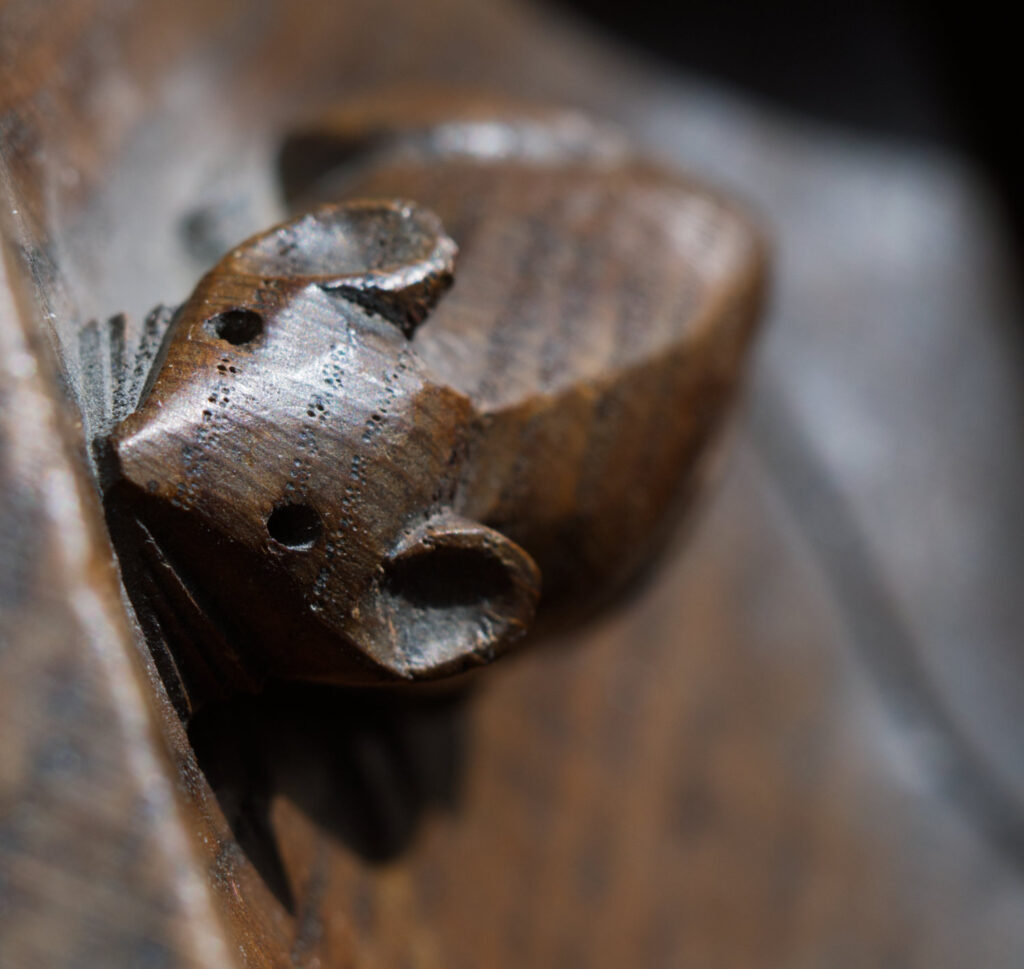
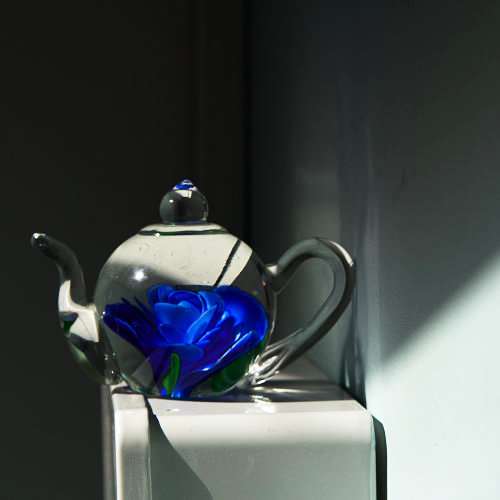
The mouse signature of Robert Thompson, the furniture maker from Kilburn, North Yorkshire. My granparents lived down the road from him, so I inherited one or two bits of furniture made by the original “Mousey” Thompson himself. This mouse is on a carved book-end. I was trying out a 1970s macro lens (SMC Pentax-M 100mm F2.8).
I practised putting up and adjusting my tripod today, so I can do it quickly and I know all the angles I can use. It’s such a good tripod (a Vanguard VEO3+). You feel confident using it because it’s so well-engineered, and it offers such a range of angles, including with the camera upside down on the floor!
Still on practising with equipment, I looked again at how to use my flash. There may be times when it’s okay to use an on-camera flash, like with a flat subject, but most of the time I’d hold it to the side of the subject. I’m planning to fix the camera on the tripod and put it on a ten-second timer. Then when I push the shutter release button, I’ll move to the side and hold the flash in the air, pointing it at the subject from an angle. I practised that today and it does create better contours and softer shadows.
I also read the instructions of my flash again because I’d forgotten how to get exposure compensation with it. Lowering the flash strength will help, and firing through a hand-held diffuser, especially if the subject is close.
So there, I feel more confident in using the tripod and flash, which will be handy as we get into the darker months.
The computer troubles continue. I discovered that none of my laptops can run a video call and a browser at the same time. This was a problem in my French class on Thursday, and yesterday with a call to R. I had to use my phone to call R. I use my desktop most of the time, and it works well, but it doesn’t have a camera, a microphone or speakers. I could just buy them, and that would be cheaper than a new laptop, but what if I need to call someone from another room, or away from home? I’m facing the prospect of buying a new laptop after all.
We had guests this afternoon then I had to go out in the evening. so that was the rest of the day.
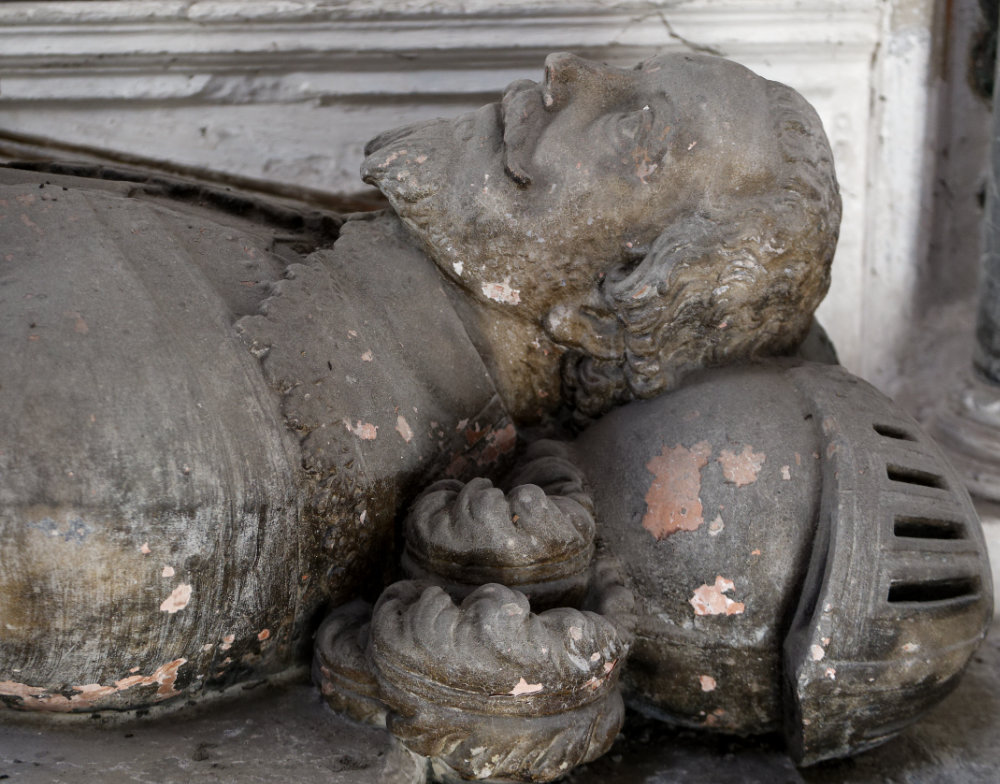
I felt I had unfinished business at Kedington church. On my last visit, I hadn’t used a flash or a tripod, and I hadn’t controlled the camera with the app. So after my French lesson I headed out, and this time I had the church to myself. Here are my findings.
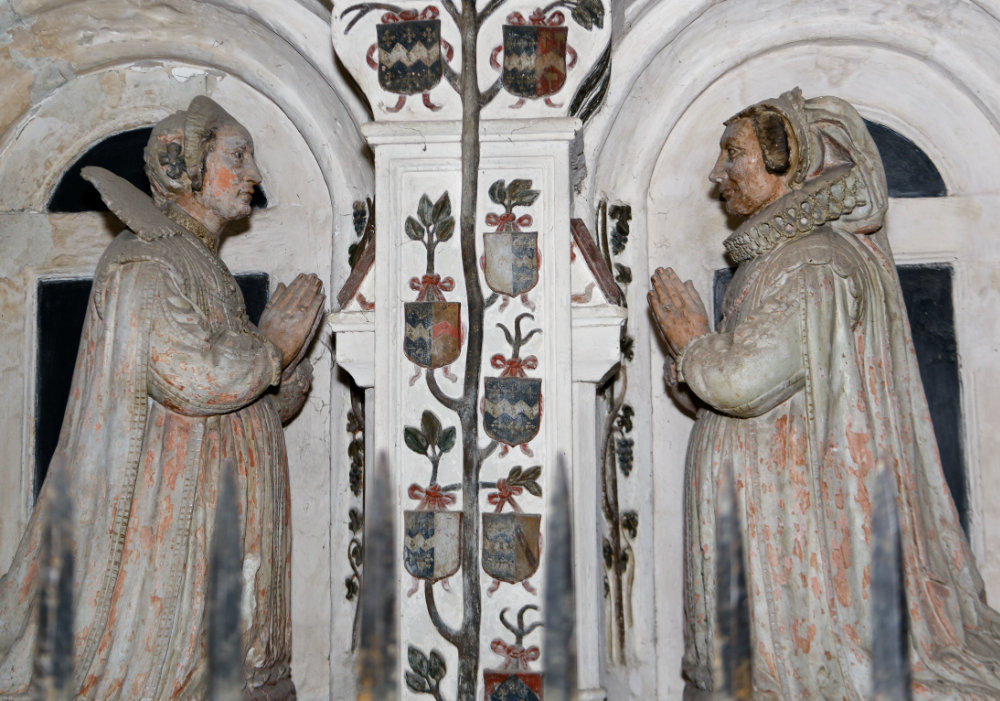
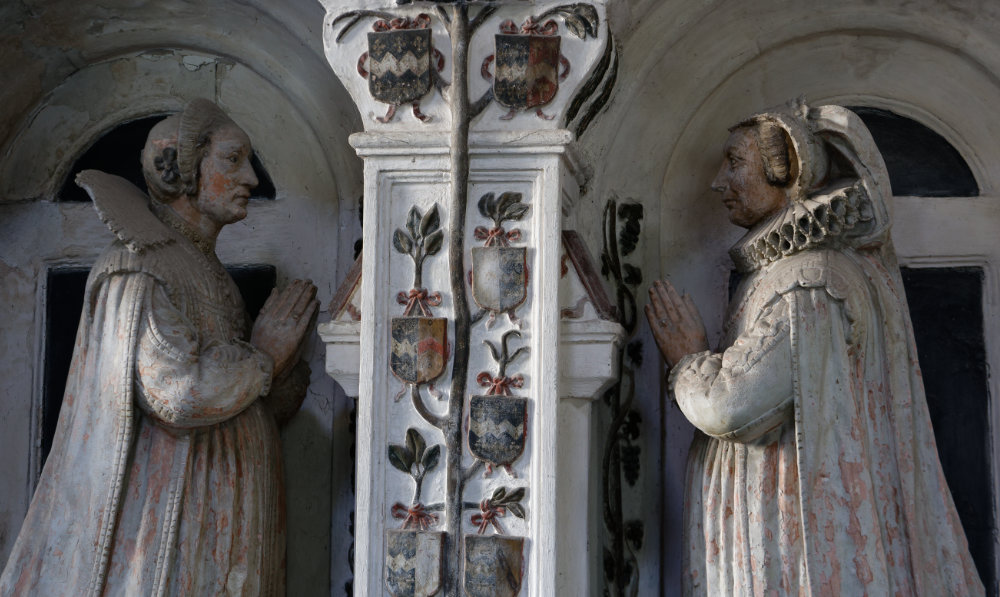
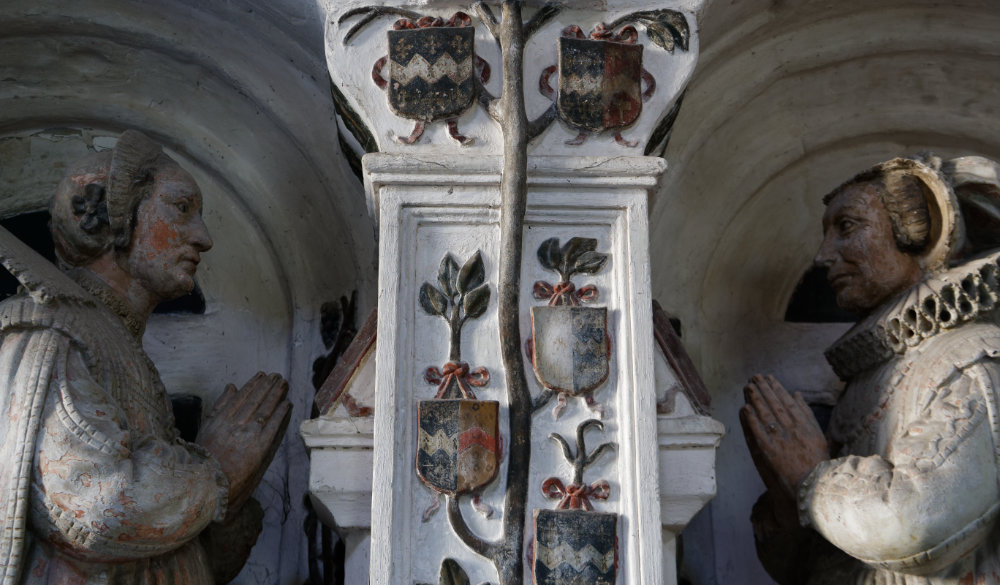
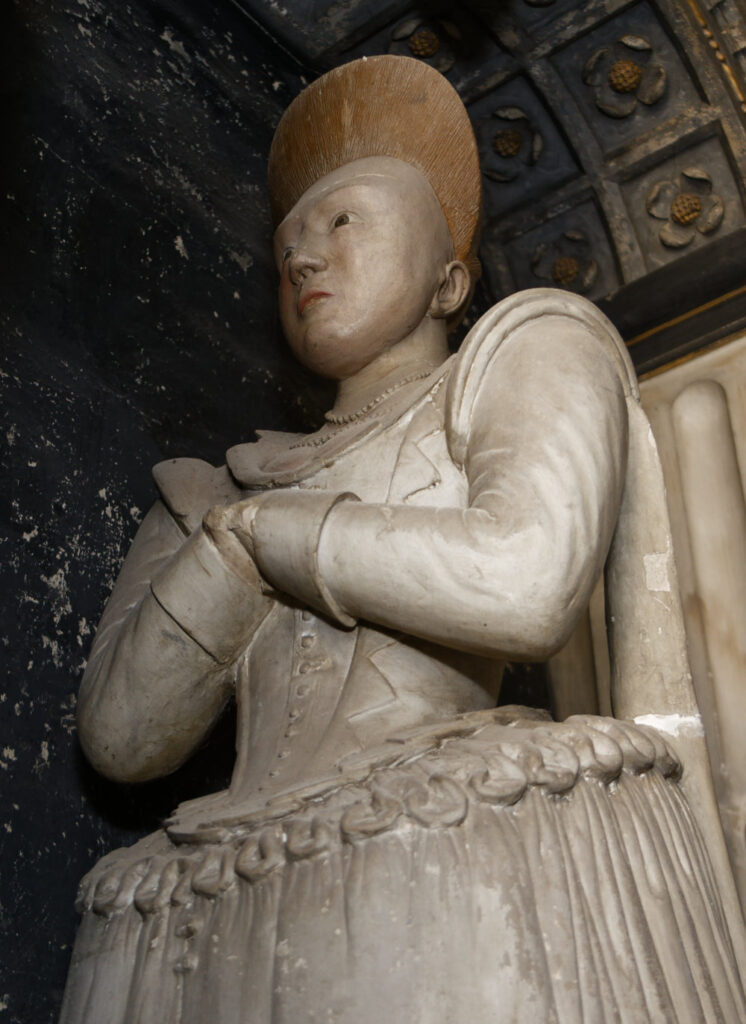
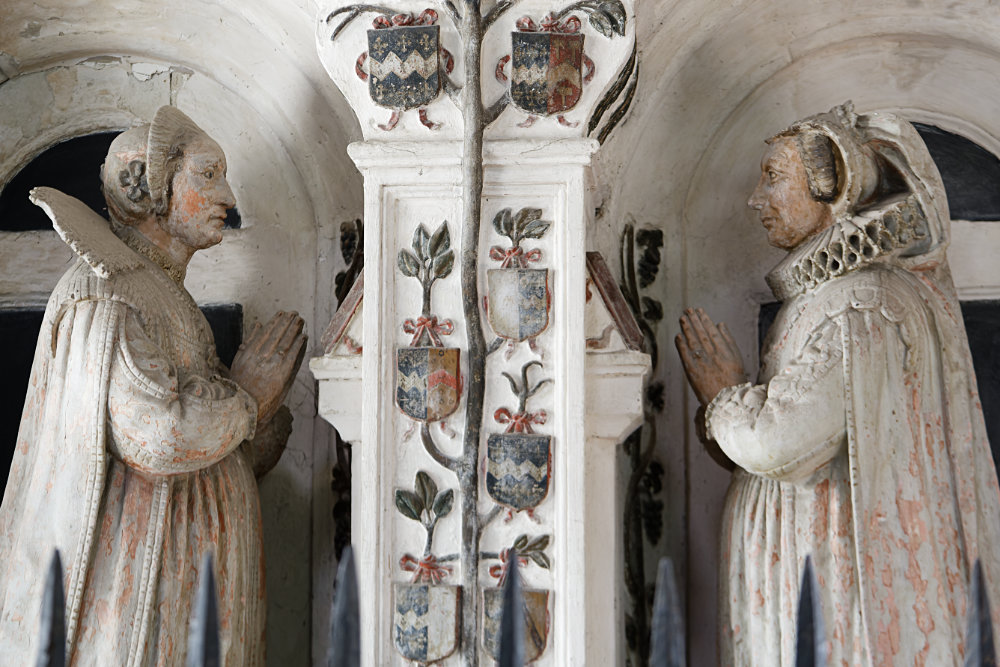
The wives of Sir Thomas Barnardiston
With an on-camera flash. I tried varying the angle of the flash head and diffusing it, but never got better than this. The rest were horrible (over-exposed foreground, dark drop-shadows, flat tones).With a tripod. This is much nicer, with tone contours and less harsh light. Unfortunately the women are in alcoves, and so in the shadow, but the light could be improved with post-processing.With the camera sitting on the top of the railings guarding the tomb. The lens was wedged between two spikes, so pretty secure, and I controlled it from the app. This is similar to the tripod image.
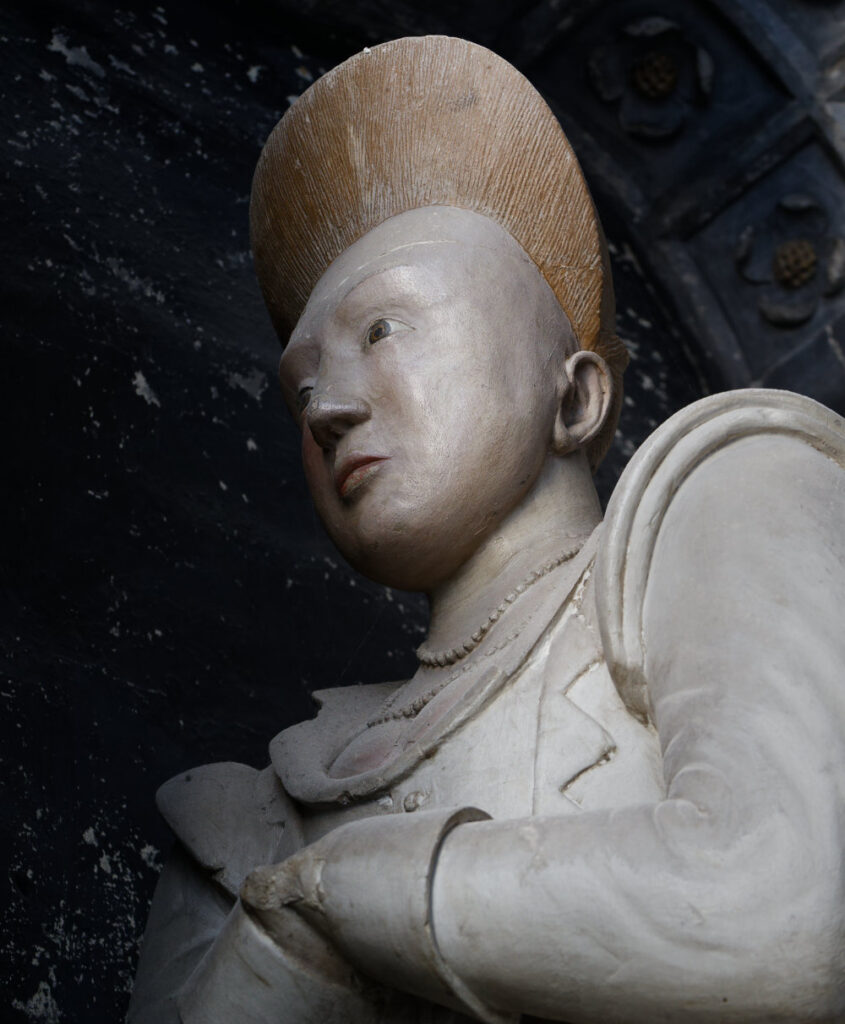
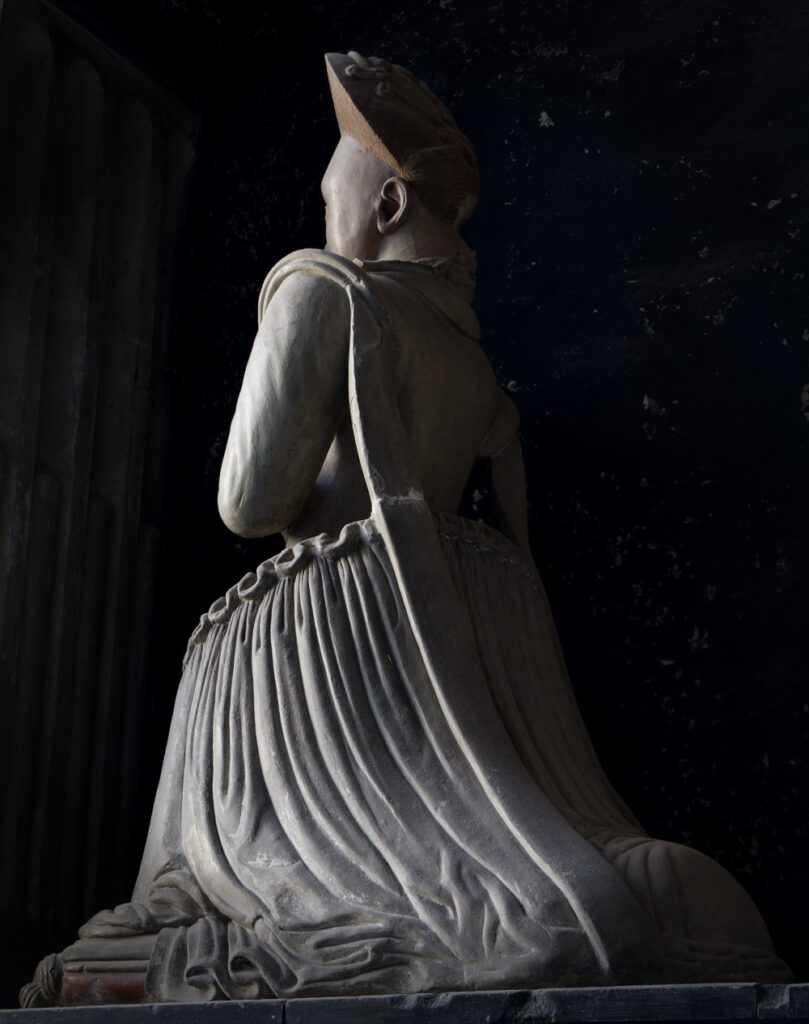
Grissel Barnardiston
With a camera-mounted flash. This was the best I could do. I had to tone down the brightness of the nearest arm in post-processing.
With a tripod. The tripod made me choose different angles than if I’d held the camera by hand. Space was tight between the tombs, so there were only so many places the tripod would fit.
With the camera resting on a shelf, propped up by the camera strap and operated remotely. Again, the need for a secure spot to put the camera made me go to different places to take a shot. Normally you (1) see something worth taking (2) move to a position to take it and (3) take the photo. When you need a secure surface (1) and (2) are reversed. You choose the position first, then look for a shot, which results in unusual angles. This is my favourite photo of the Grissel Barnardiston sculpture, even though you can’t see her face. The lines are lovely, and it’s like you’ve caught her alone praying. It would work well in black and white.
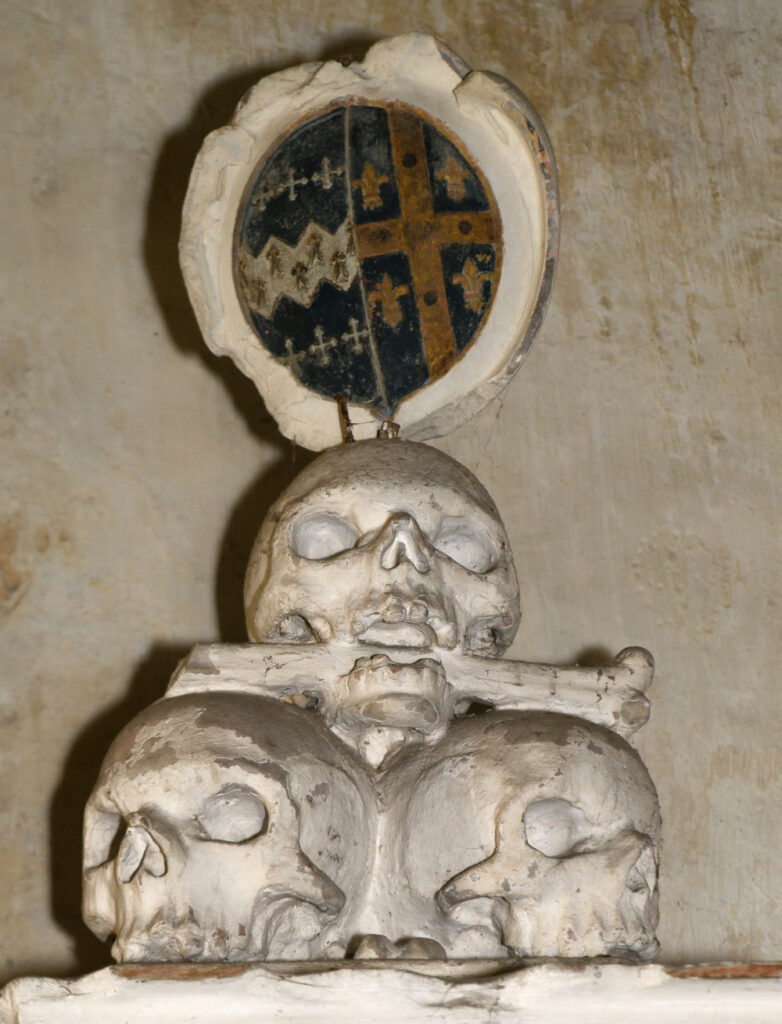
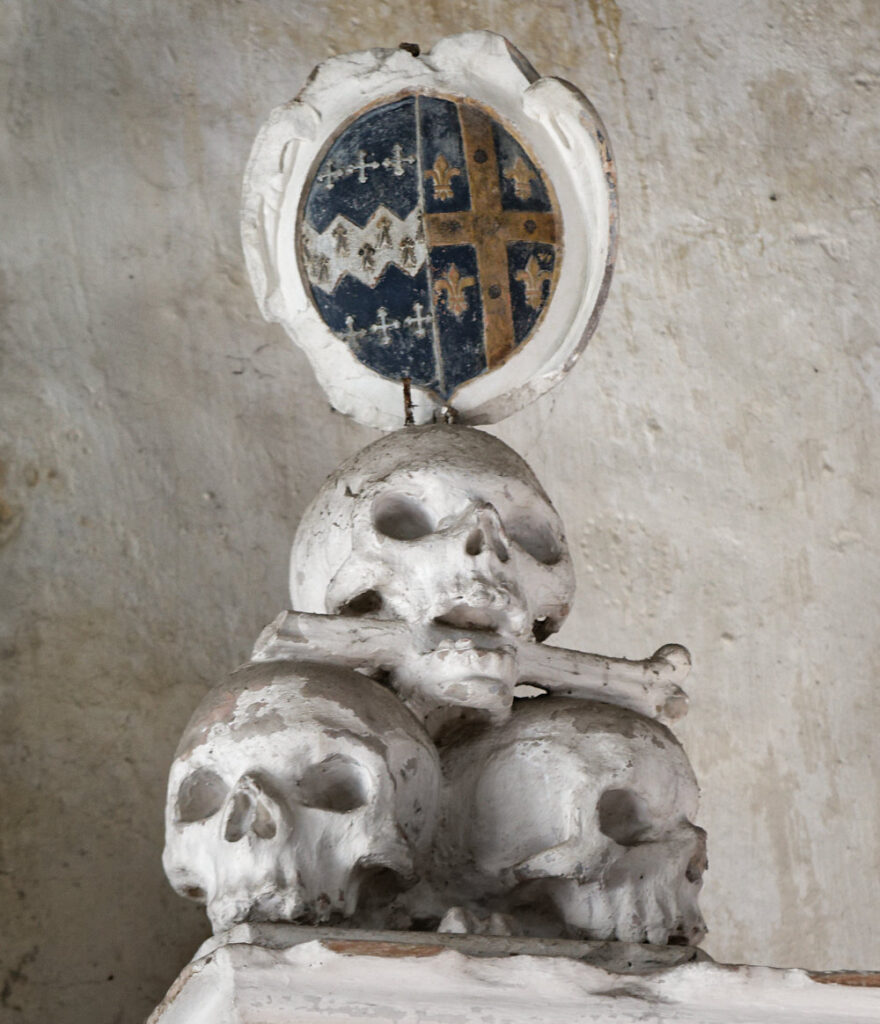
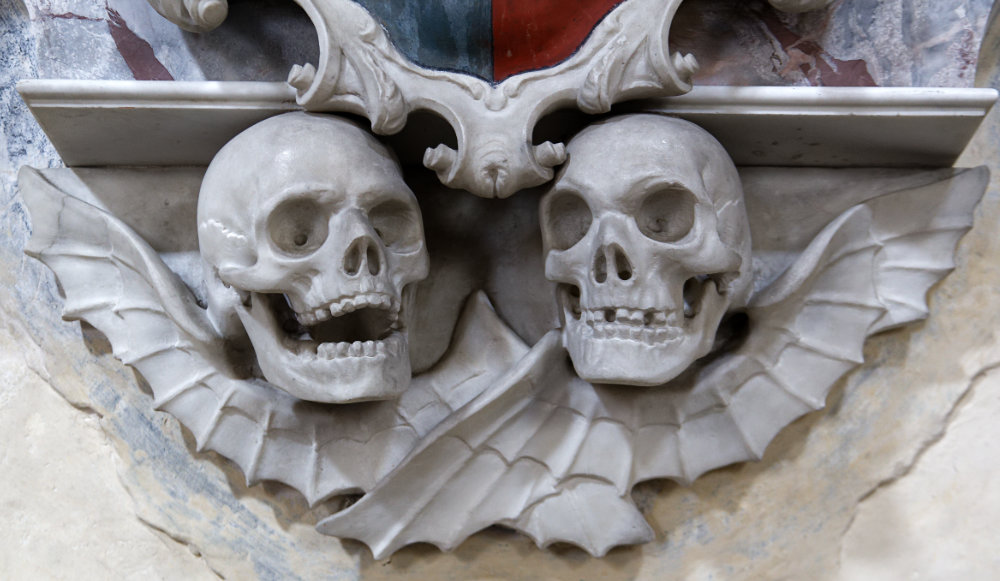
The skulls
With a flash. The colour balance is wrong with the flash photos, I notice. Presumably that was set before the flash fired. Anyway, more horrible drop-shadows.
With a tripod. Much better, even though the skulls were up on a dark wall. I couldn’t take a version with the camera resting on anything, since there was nothing at the right position.
With the camera resting with its back on the floor and controlled by the app.
Conclusions
On-camera flash is horrible. It looks better when you can bounce it off something, but the church just swallowed the light. Even with a diffuser attached to the back of the flash, I had to point it almost directly at the subject.
The tripod and app control techniques give you new angles you wouldn’t ordinarily think of. I was impressed with the creativity that the app allowed, because you could put the camera in places where you couldn’t see the back screen or look through the viewfinder.
I need to practise using the tripod more, so I can get faster with it. I struggled with it a bit today – just simple things like extending and shortening the legs – so I need to get familiar with it.
All of the above methods made better quality images (less noisy ones) than hand-holding the camera and using a high ISO, like I did last time.
It’s worth varying the techniques when you go somewhere, to force you to look in a different way.
I’ve got to watch the aperture of my leans. At its widest aperture and longest zoom, my lens gets a bit fuzzy away from the centre. I keep forgetting that.
I ran out of time to try one more method: putting the camera on a tripod and then triggering it remotely whilst holding a flash away at the side. This should give better contours to the image than the notorious on-camera flash. It’s probably not a good idea for old objects like these, though, because I remembered today that flash light can eventually fade paint, like the paint on murals and sculptures.
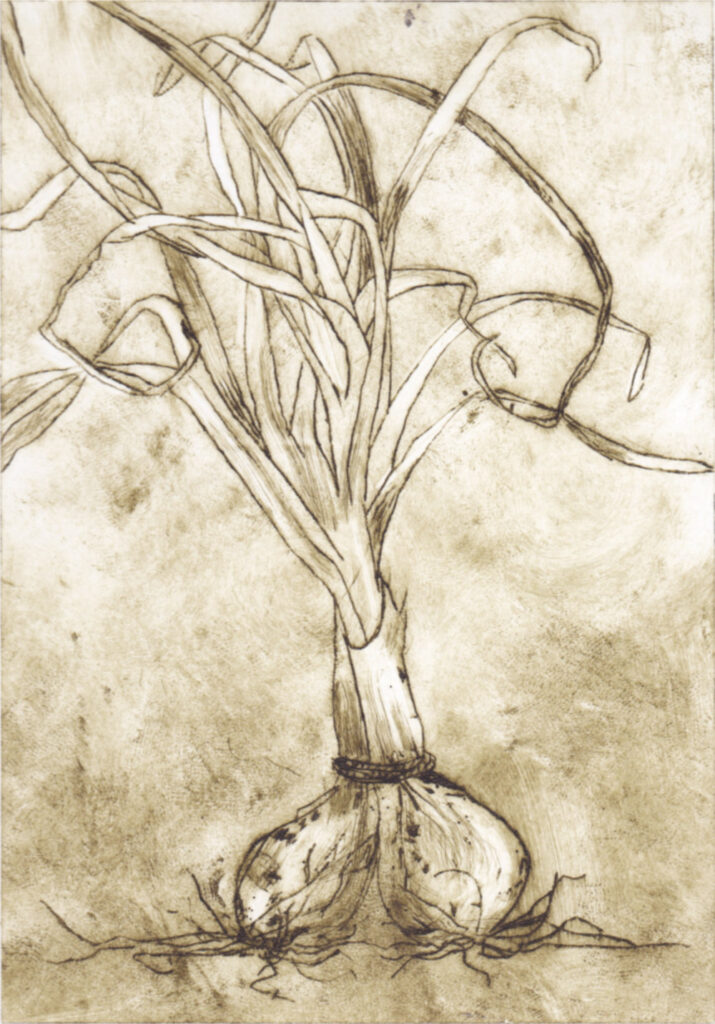
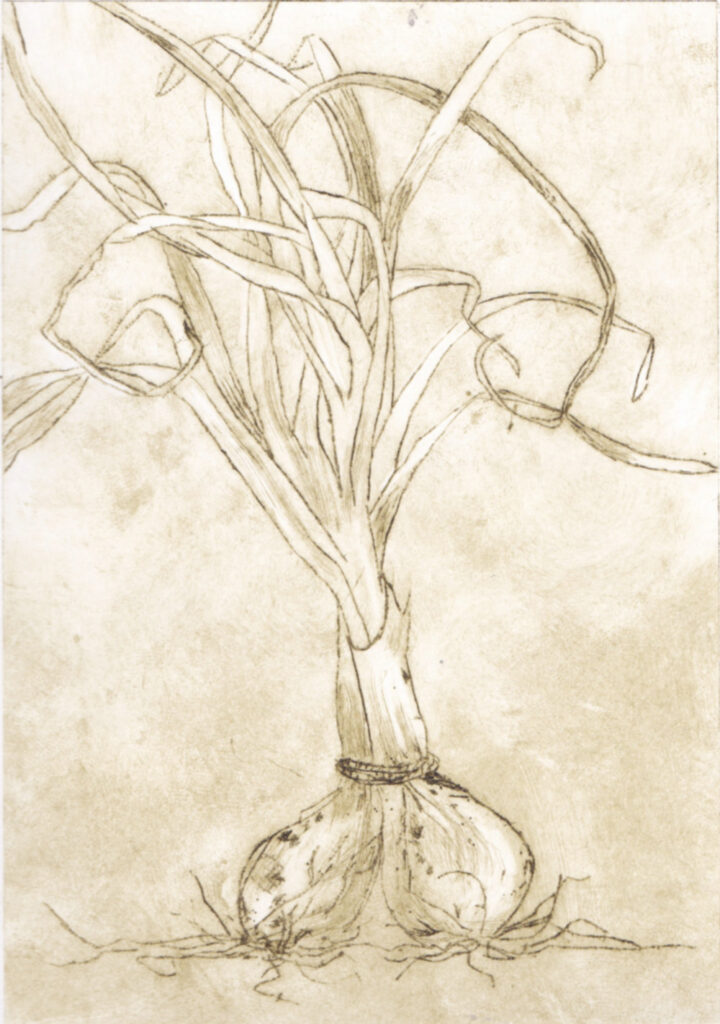
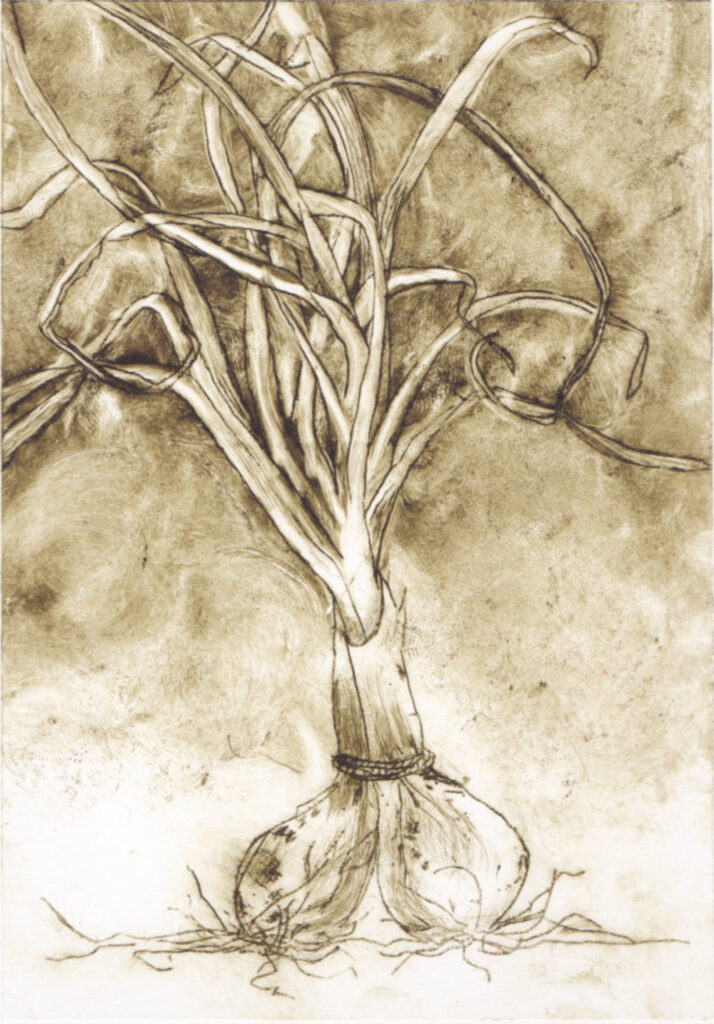
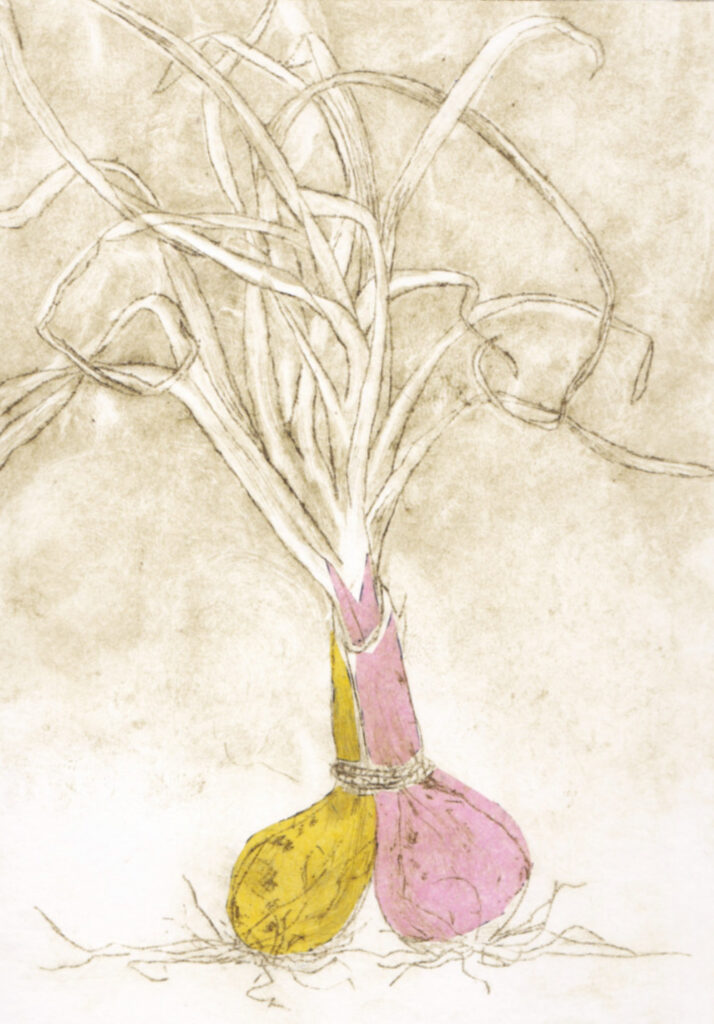
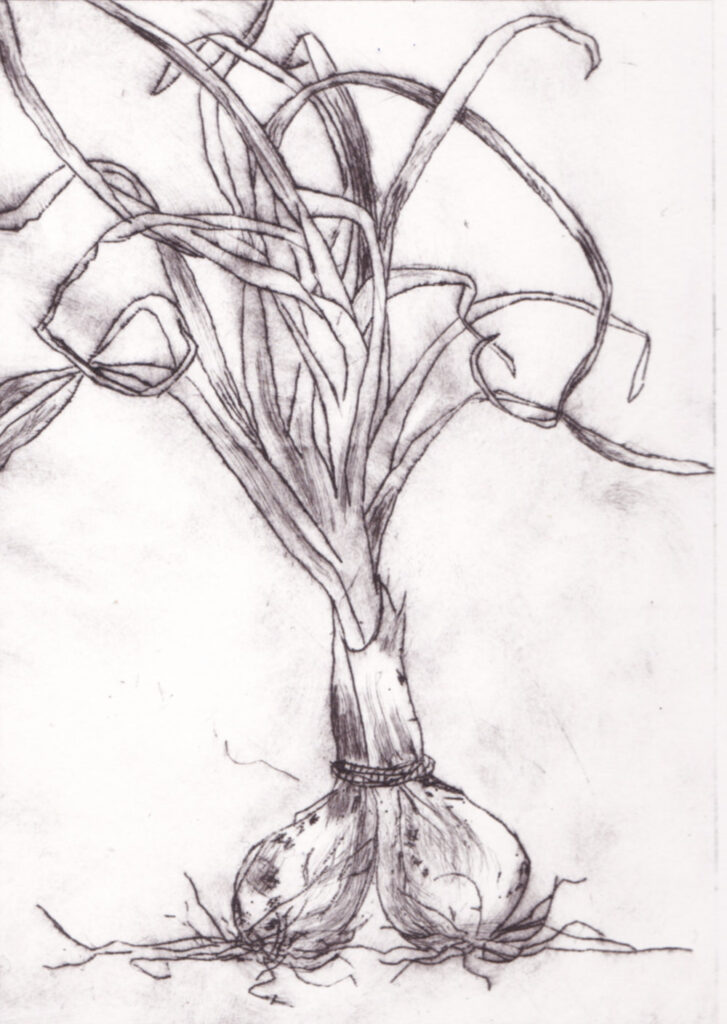
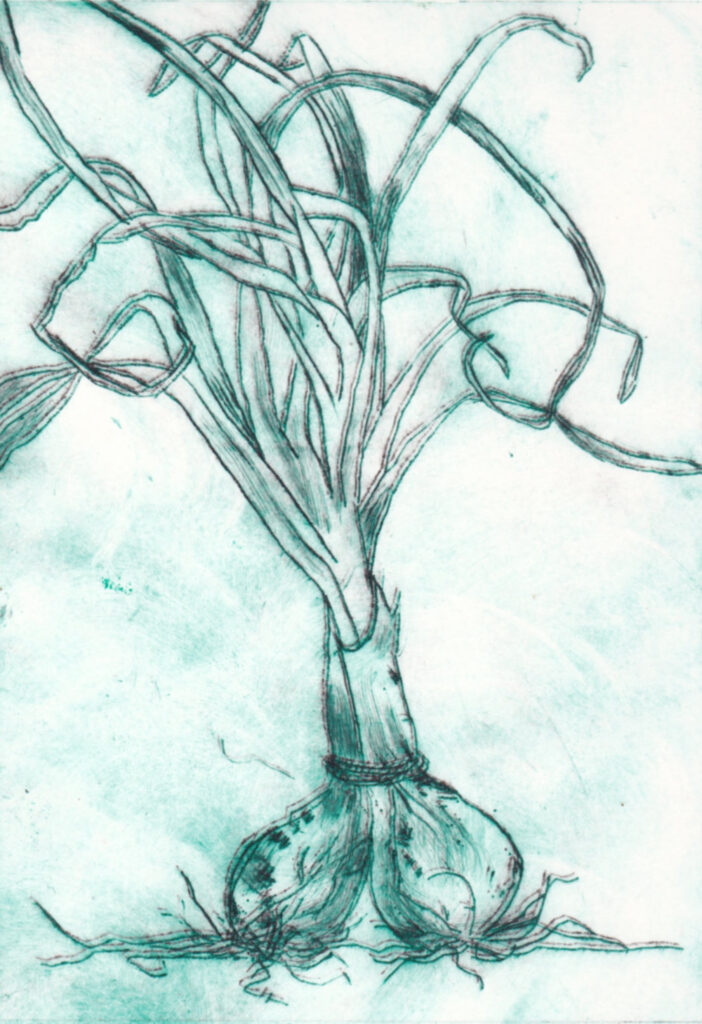
The second week of the printmaking course, and this time it was drypoint etching. The vegetable theme continued from cabbages, because today the teacher thought my photo of onions would work best. The stalks had been chopped off so I copied some stalks from an Edward Weston photo, and made some up.
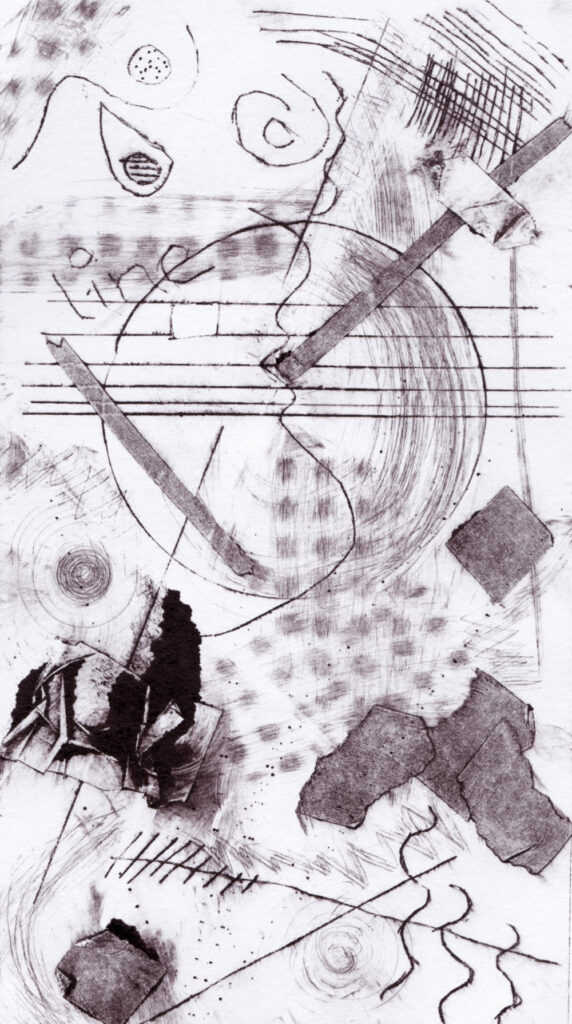
We started off with a test sheet, to try out different techniques (we were engraving on acetate).
This was followed by variations of our real picture:
In sepia ink
As above, but a ghost print ( a second print, so fainter)
A re-ink of the plate with sepia, but this time with the dark background at the top rather than bottom of the image. I prefer this. I rubbed the ink off the stems with cotton buds.
The ghost print with Chine collé (tissue paper pressed onto the image)
A black version, which was a preparation for the next print.
You don’t need new glasses. I superimposed a green print on the black one, but offset it slightly. I’m not keen on the effect!
I went down to Haverhill for a haircut. Haverhill is a run-down town with many closed shops that the local council has camouflaged by putting pictures in the windows. I do like a barber’s off a side street, though. It’s just one woman in a small room with three chairs for waiting. You can have a chat with her, and this is something the Turkish barbers that have spread across this country don’t understand. You don’t go to barbers to get pampered, you go to pick up gossip. I don’t want coffee or a nose pluck or some funny smelling pomade, I want to hear local rumour and scandal.
There wasn’t much scandal today. We just chatted about supermarkets and vitamin supplements. She has chia seeds in her porridge for breakfast, like me. You would never guess to look at her – a middle-aged peroxide blonde in a side street in Haverhill. But then what would she have for breakfast? It’s humbling: I can’t even guess what people have for breakfast, let alone their moral and political opinions.
After the haircut, I thought I’d wander round the town and take some photos, or do some sketches. I settled down on a bench on the high street, and watched people. I’ve never known a place where people look so down-trodden. I’ve noticed it before when I’ve been there, but it’s only when I sat on a bench and looked at people that I realised how bad it was. One in ten people seemed to be on a mobility scooter, including many young people who were too obese to walk. Then I’d say another four in ten either had a walking stick or a problem walking, and again that wasn’t restricted to old people.
I’d seen a young couple earlier on, and I’d thought “Well, I guess he can’t walk very well, but at least they’re happy there, holding hands.” The young man lumbered left and right when he walked, and one foot was permanently tipped to the outside. I followed them in a shop and the assistant said, “What is it today, then?”
The young man said what sounded like, “Whop!”.
“Oh, books is it?” said the assistant.
When the couple moved down to the back of the shop I heard the man crying, “Whop! Whop!” and realised that was all he could say, and that the woman with him was his carer. She glanced at me self-consciously, as if she was afraid I’d disapprove him.
I asked myself whilst sitting on the bench, “What do I mean by ‘down-trodden’? If the people here are ‘down-trodden’, what does that mean exactly?” That’s one for my thought book, but here are some quick notes:
Visibly poor health: difficulty moving (needing a mobility scooter or a walking stick, having a limp or shuffle); overweight or painfully skinny; pasty skin and bad complexion (not rosy, healthy cheeks due to fresh air and exercise).
Dressed badly: cheap clothes made of synthetic material, like jogging trousers and plastic trainers; jumpers without shirts underneath; stains and worn patches on the clothes; clothes that aren’t attractive or don’t suit the person’s figure.
Messy hair: badly-cut hair dried and frazzled, or lank with grease.
Vaping: many people were doing this, including shop assistants popping outside for a quick drag.
Those are some ideas. I could have added “Wearing a medical monitor”, since I saw a young man covered in tattoos sitting with his girlfriend outside Costa Coffee. The man had a blood pressure cuff around his arm and he was watching the monitor on the table. The whole centre of town is like an outpatients unit.
For all the observations I made above, and me calling them “down-trodden”, the people didn’t look any less happy than people anywhere else. Still, I couldn’t get my camera or sketchbook out. I just couldn’t because I found it all too sad.
I drove up to Kedington, and took some pictures of the church. There are some fantastic sixteenth and seventeenth century sculptures there, so I thought I’d try using a remote flash and tripod in gloomy conditions. Unfortunately, a couple of men were wandering about trying to fix the organ. I asked if I could take photos and one of them (I guess the local) said, “Yes, that’s fine. Go ahead.” But I couldn’t bring myself to set up a tripod and flash, Instead I tested how much I could do in available light.
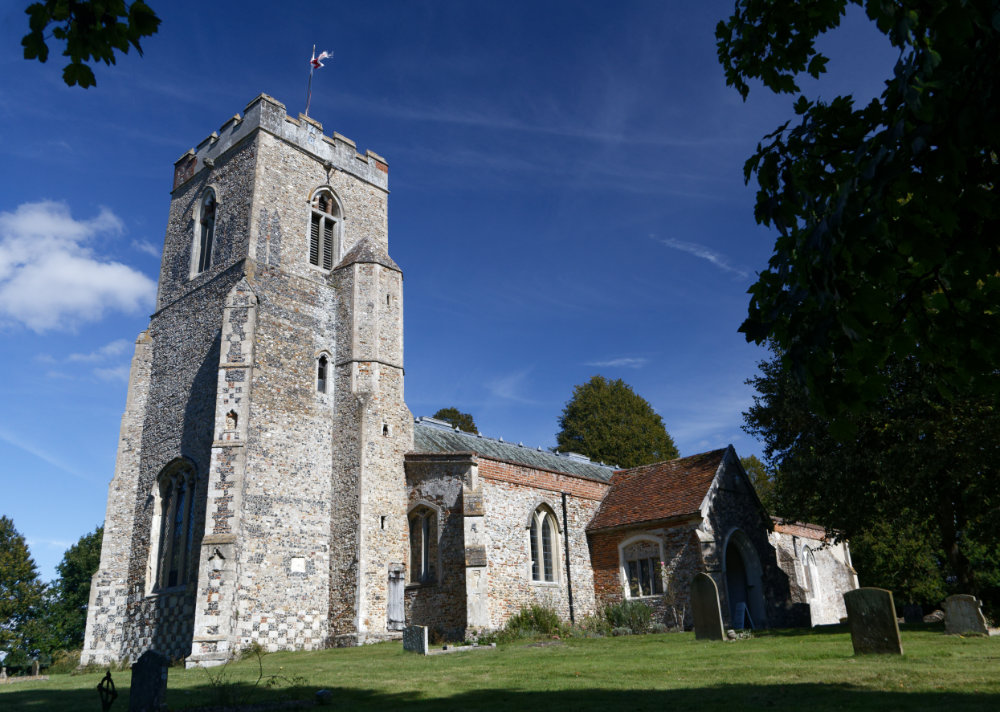
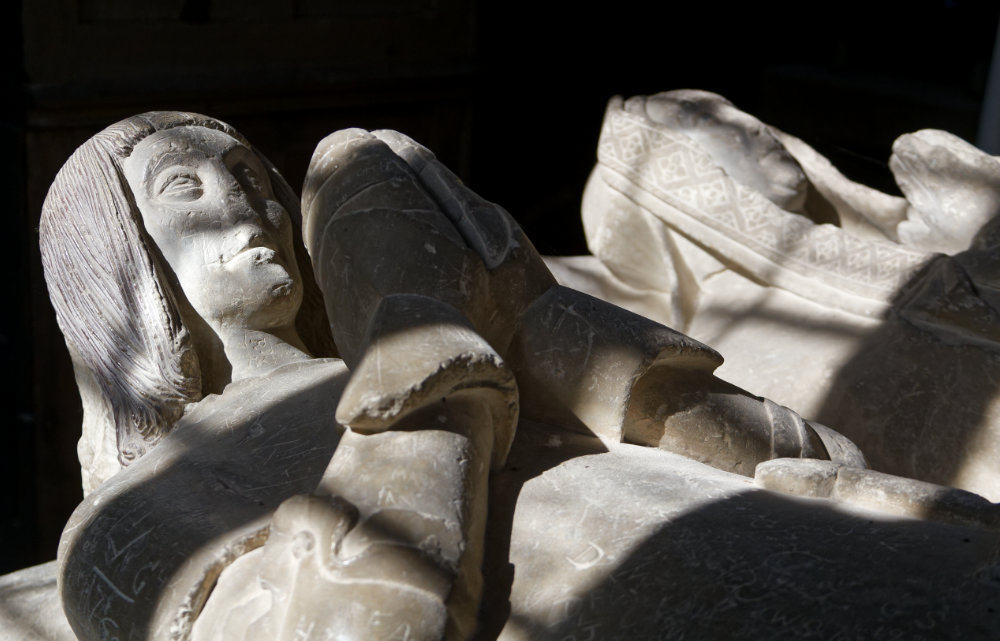
Here’s the church. I wonder why they stopped the chequer stonework at the bottom of the tower.Sir Thomas Barnardiston (d. 1503) and his wife Lady Elizabeth (d. 1526). It’s a shame I couldn’t get her in focus as well. I could have tried taking the same picture twice, each focused on a different face, and stacked the two pictures. But I would have needed a tripod.
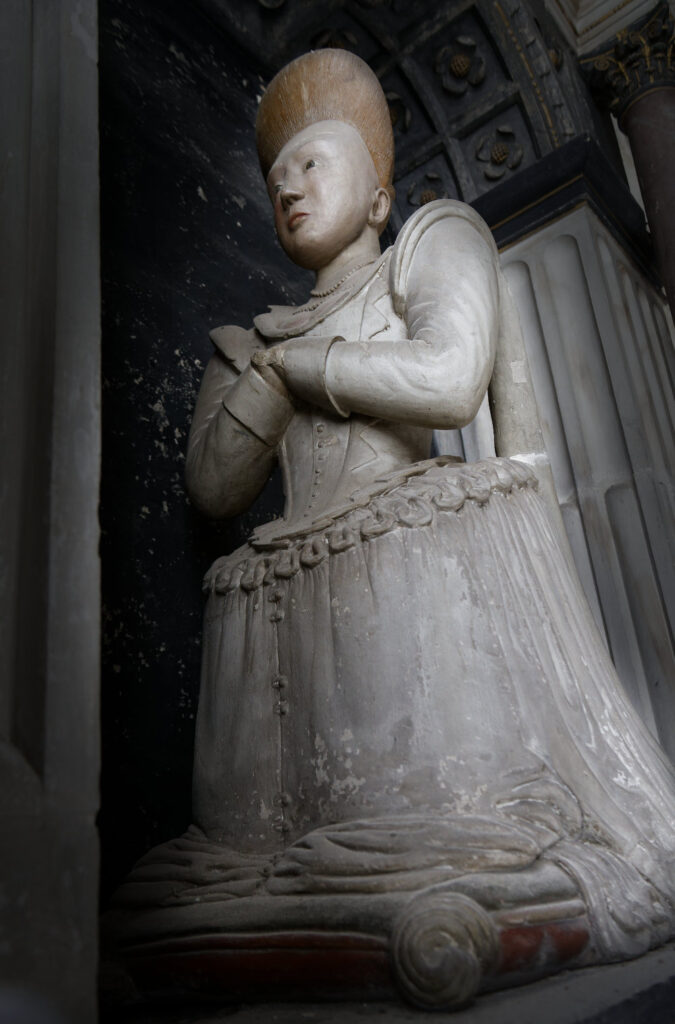
Miss Grissel Barnardiston (d. 1609). The inscription says she was “Too deare to Frendes, too much of men desier’d, Therefore beraft of us with untymely death.”
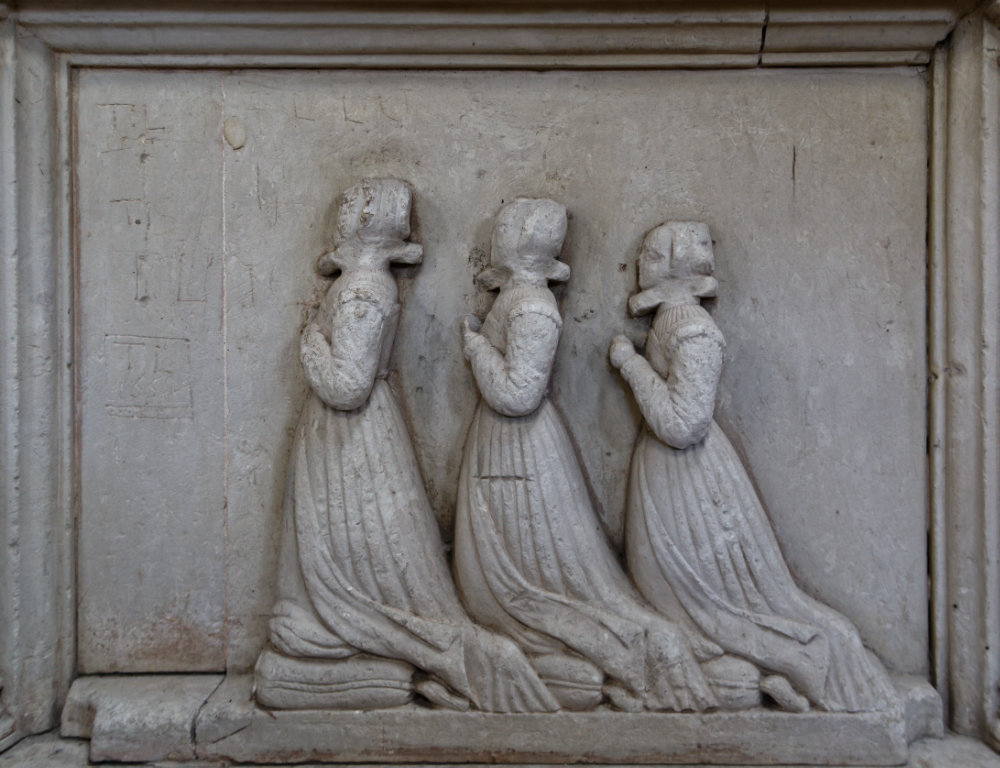
The three daughters of Sir Thomas Barnardison (d. 1619) and Lady Elizabeth (d. 1584), carved into the side of the couple’s tomb.
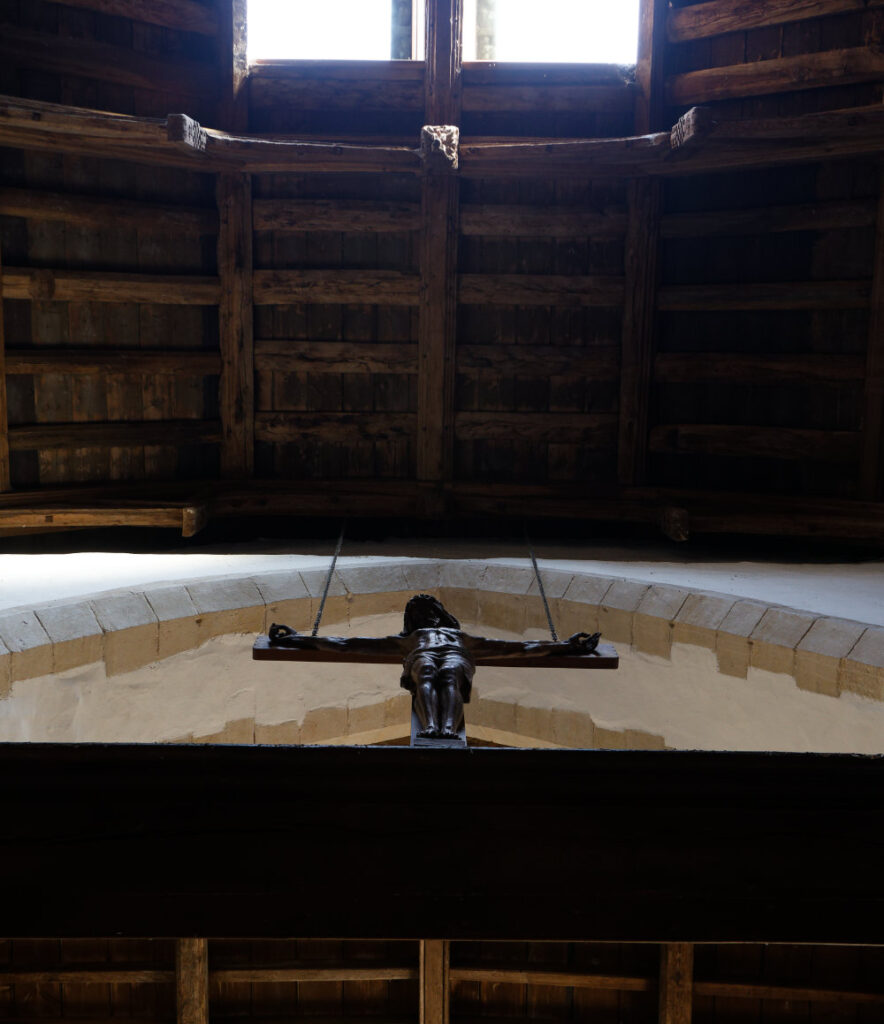
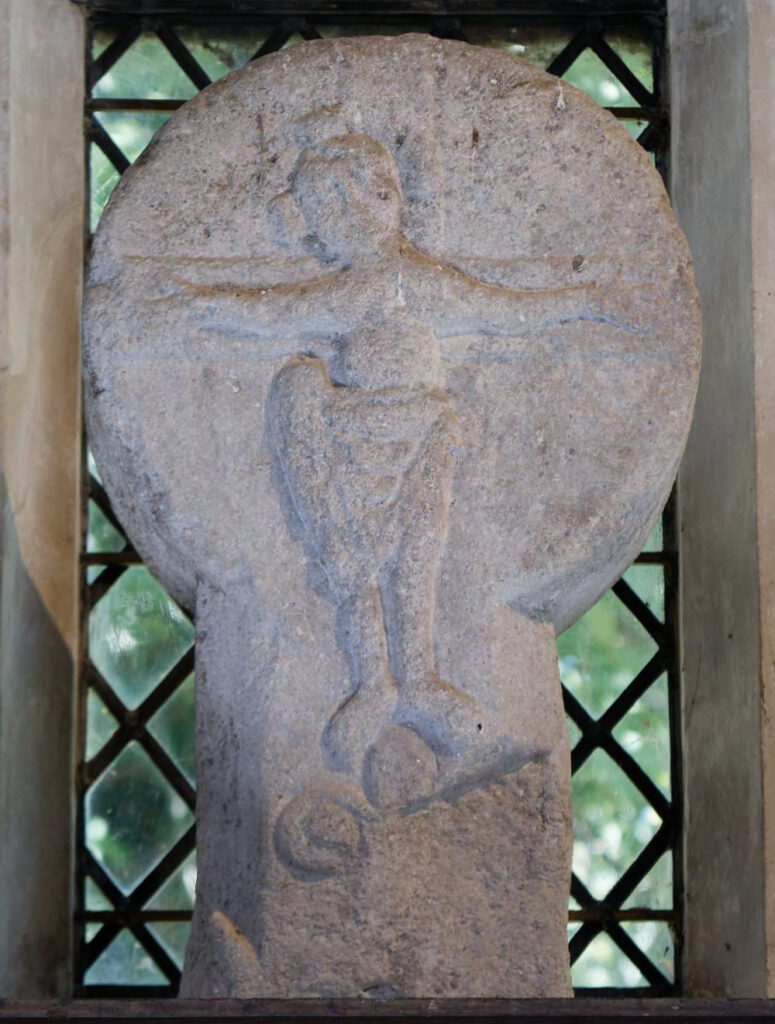
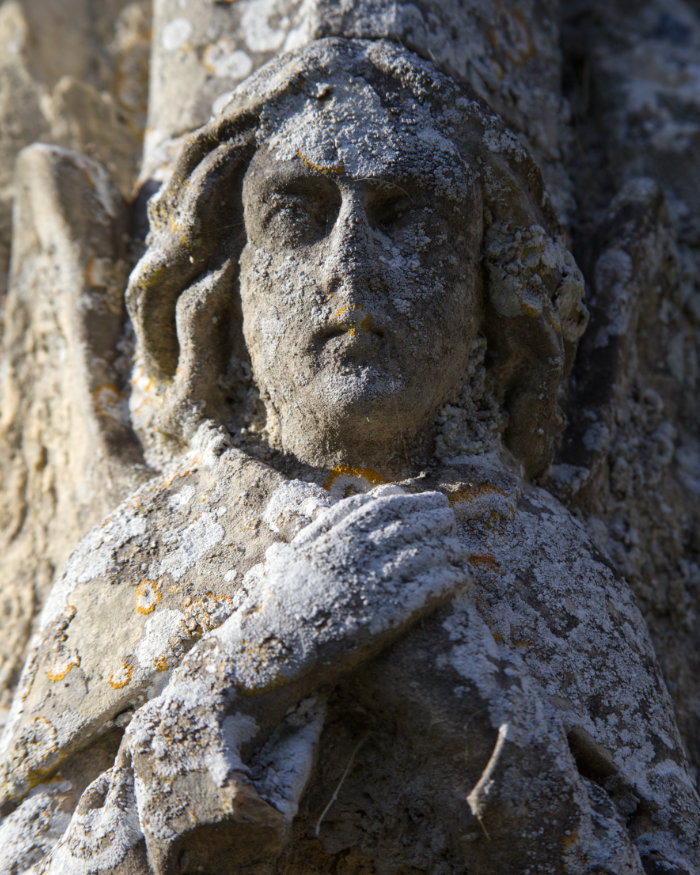
The site of the church was used for Christian worship in Roman times, when stone crosses marked a place for worship. This figure is from the top of the stone cross that existed in 900AD.
The two wives of Sir Thomas Barnardiston (d. 1610): Mary (d. 1594) and Katherine (d. 1632).
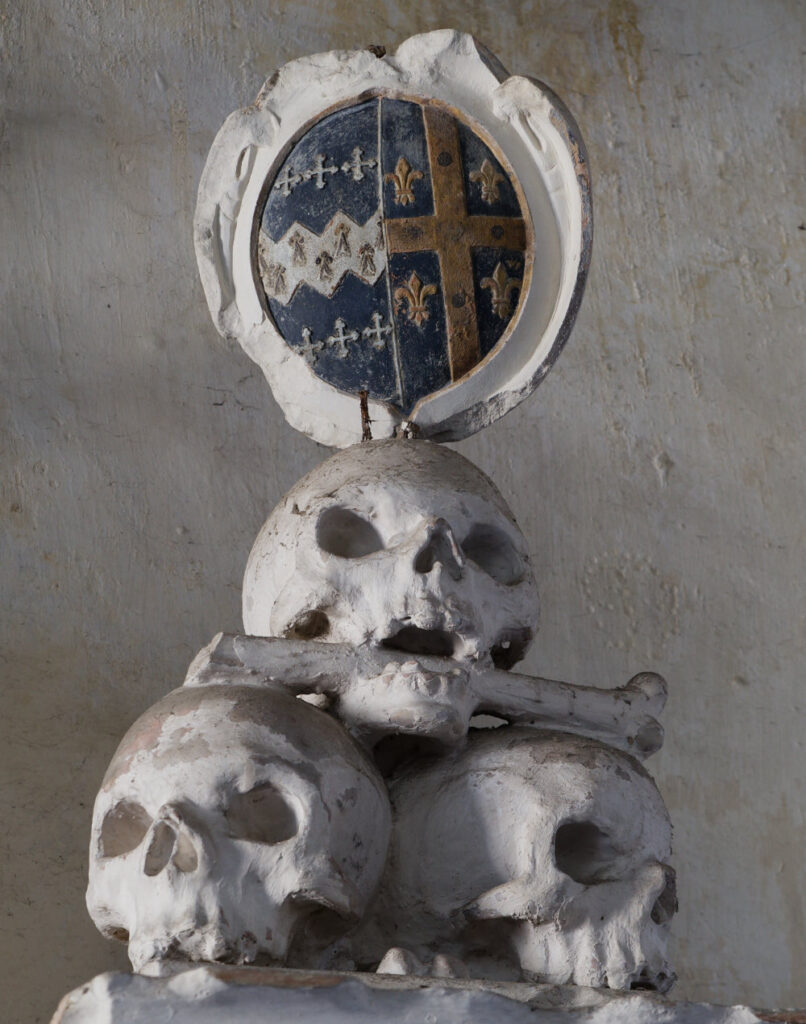
Skulls on Sir Thomas’s wall monument.
Sir Thomas himself (d. 1610), husband of Mary and Katherine. It was very dark where he was lying, so the quality isn’t great.Skulls that reminded me of Stadtler and Waldorf from The Muppet Show. They look like they have the same sense of humour.
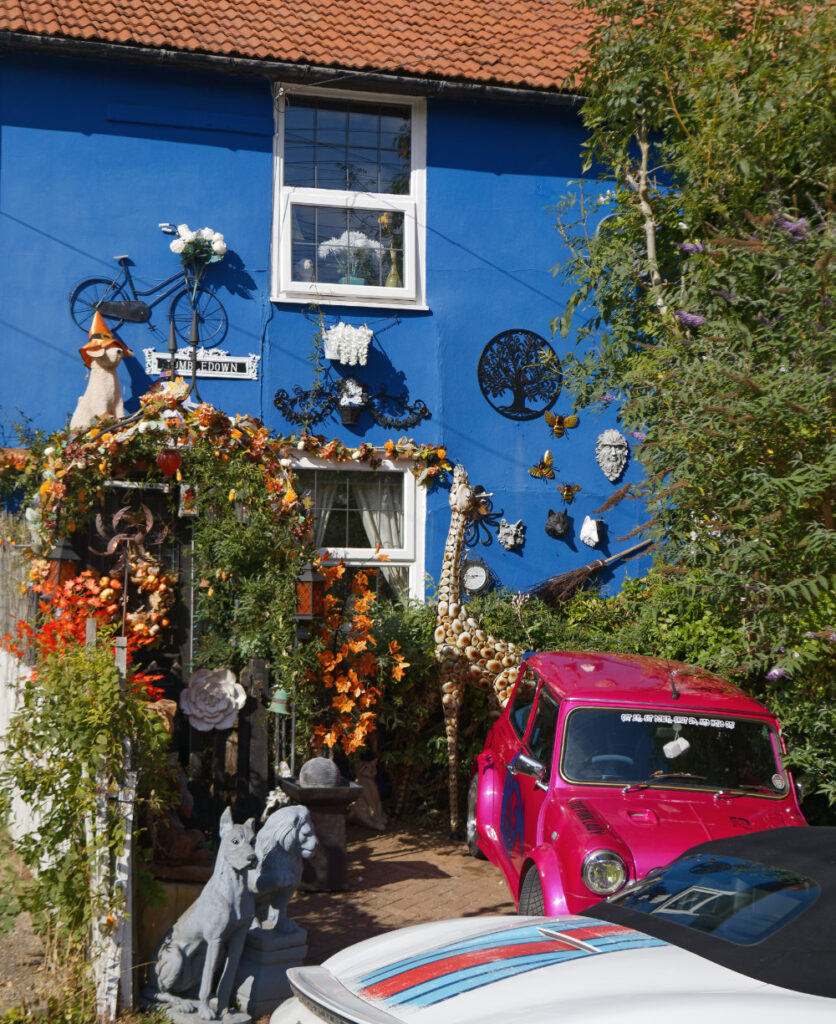
Then, as light relief from tombs, I took a stroll around the village and found a couple of eccentric houses. First this:
The items on the wall include bees, the heads of wolves, a witch’s broom, a bicycle and a clock. In the garden we have a dog, a lion, a giraffe and an orang-utan under the big white flower. The sticker on the car windscreen says “Get in, sit down, shut up, and hold on!”
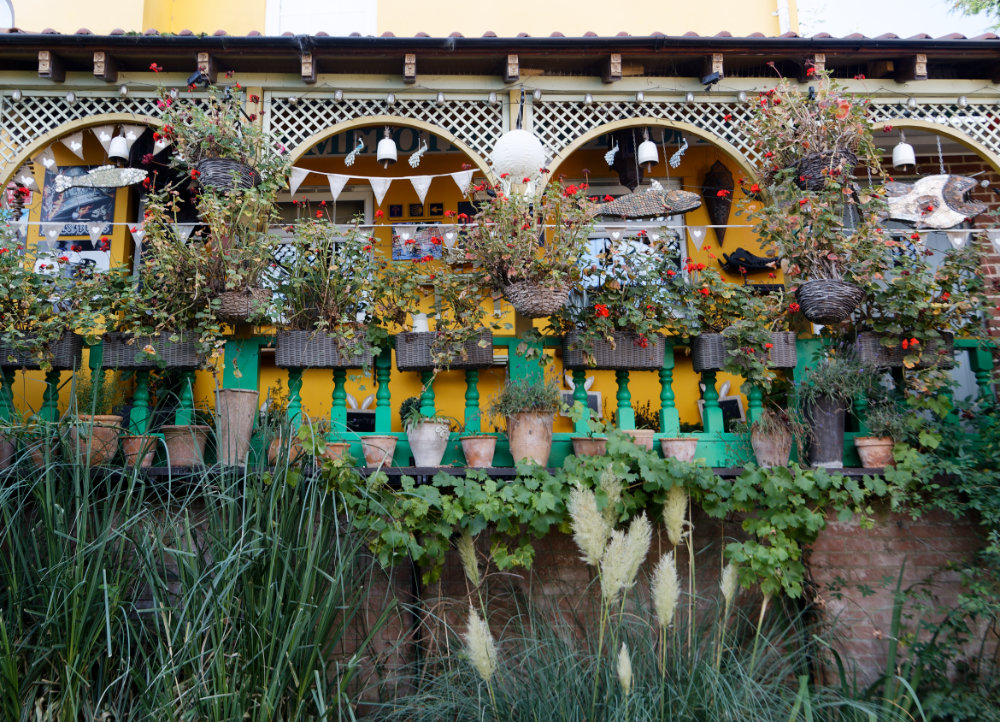
And then just a few doors down was a yellow house that had a replica Mediterranean terrace down the side, complete with balustrades and pots of geraniums. Above the terrace, high on the wall, was an enamel picture of a silhouetted rabbit with the words “Death comes to us all, and it has sharp scary teeth.”
Enamel signs for Motorhead, AC/DC and The Grateful Dead lined the wall of the terrace.
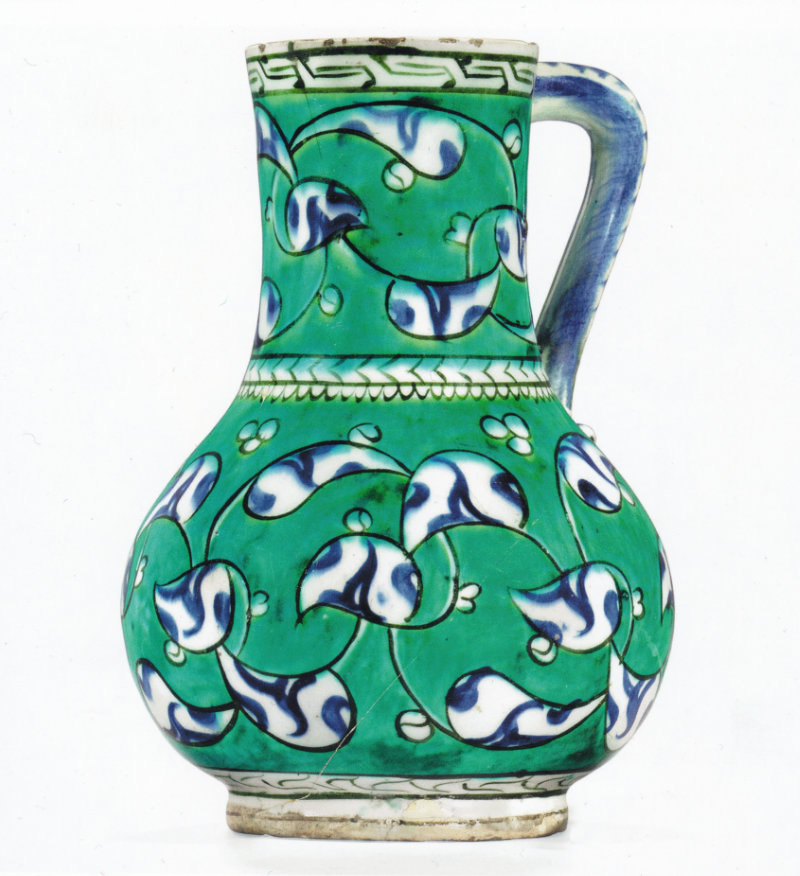
I’ve got an art calendar with a picture a day, and here is today’s picture:
It’s an Iznik pot from the sixteenth century. What a beautiful object. I love the motif and the colours. Normally these pots have blue as the dominant colour, but this green is stunning, and the motif is hypnotic. I could just keep looking at it.
Today I decided to organise my art stuff, and add sketching materials to my day bag. I found some swatches I’d done for a water colour set, and I remembered the set well – it was the last one I’d used – but could I find it?
I rummaged through everything under my desk, then in the cupboard next to my desk. I looked in the girls’ bedrooms (in case they’d borrowed it), hauled everything out from under the stairs, and finally I emptied the shed where we put the old art stuff. That was a five-hour job, because we’d bought the shed and dumped everything that used to be in the conservatory into it, just before the builders took the conservatory down. So amongst other things there were boxes of electric leads and CDs, bits of broken furniture, old pots and jam-making pans, a pressure washer, rolls of paper, an old sewing machine, and two chests of drawers containing stationary and art stuff.
It was good to go through all the art stuff, especially the paints and brushes the children had been given since they were toddlers. I threw a lot out, fixed the drawers whose bottoms had fallen out, and tidied my own art stuff. I know where everything is now, except the paint set I was looking for. I’ve still no idea where that’s gone.
I then realised that the swatches were for a different watercolour set, and the watercolour set they were for was sitting in a newly-tidied drawer. So now I have everything in order, and have brushes and ink pens to go in my day bag.
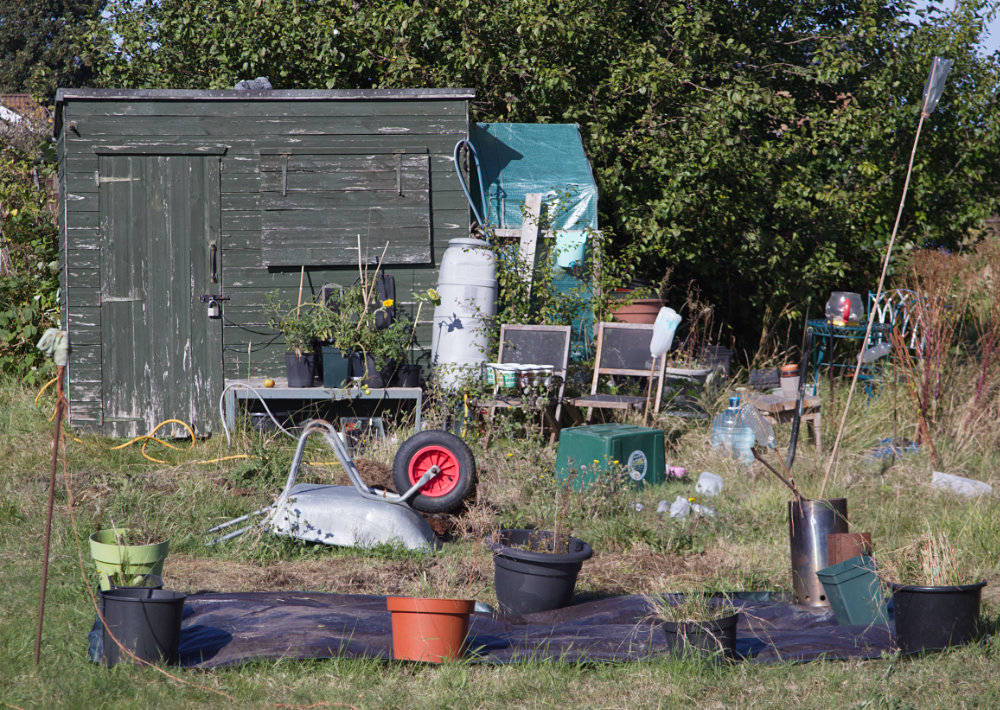
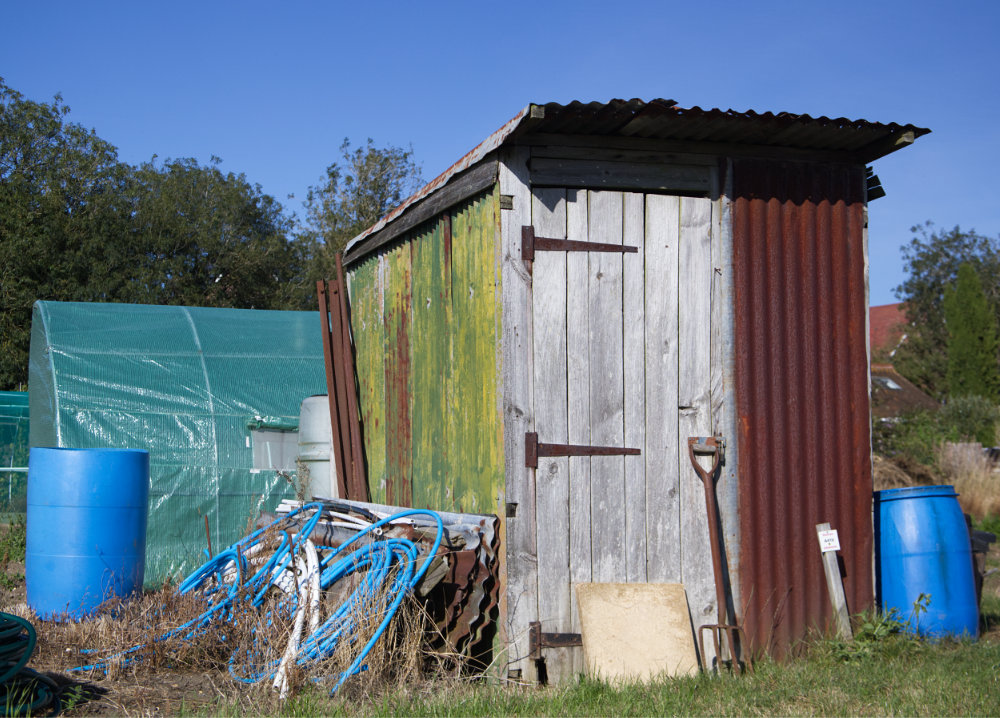
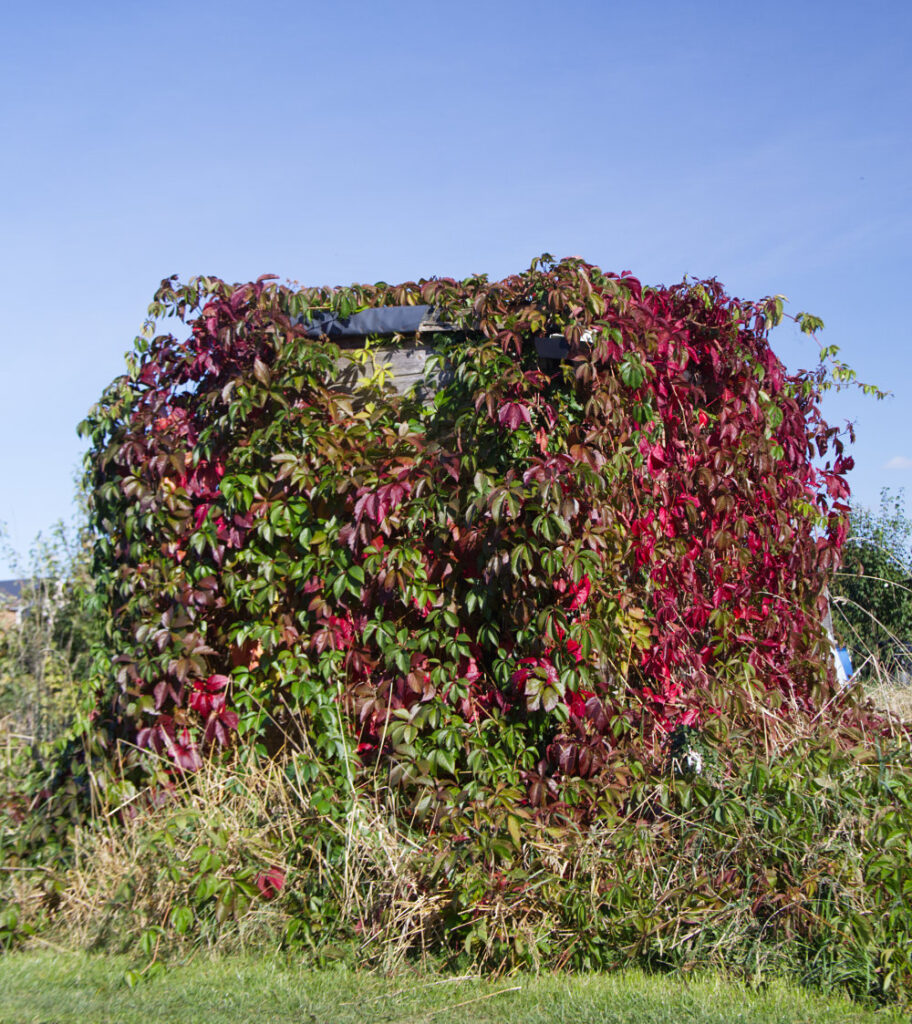
As a break from shed-tidying, I popped down to the Post Office to send a birthday card. I walked through the allotments on the way back and, since it was a sheddy kind of day, I took these pictures:
A person’s allotment shed is like their handwriting: it has a unique style. Some sheds are freshly painted, with neat rows of seed trays inside, tools leaning tidily in a corner, and a shiny padlock on the door; whilst others are keeling over like an old boat, have mouldy cloth hanging over the windows and a paving slab keeping the door shut.
I like the colours and shapes on and around this shed
This one is quite a statement. It’s swamped in Virginia creeper, and reminds me of those artists Christo and Jeanne-Claude, who wrap buildings in plastic and call it art. Maybe it is, I don’t know.
I spent the last day of my first week in just the labyrinth I swore I’d avoid: getting things to work on Linux. I’m determined not to buy another laptop when we already have three old ones, and I’m being careful with money. So I squandered the entire day installing different flavours of Linux on the most recent old laptop, which is about seven years old, and then seeing if videos and image editors worked on it.
I compared it to the other old laptops, and curiously the laptop from 2006 with Linux runs the same speed as the laptop from 2017 with Windows. It’s true, it’s a lightweight version of Linux (Emmabuntüs), but I also tried Linux Lite on the 2017 machine, and it’s not a lot faster than Windows. It’s quieter, though, because the hard disk isn’t continuously whirring. The configuration of the computer must be poor. It’s a touchscreen, so maybe that hoovers up memory.
Late at night, I concluded that no Linux distro will make a Windows machine a fast computer. It will lift it from being unusably slow to adequate, and that’s all. It will be adequate for web browsing and text editing, but not for image or video editing.
I also concluded that I need to do image editing on a large screen, and a 14-inch laptop screen is too small. So I’ll use the latest laptop as a notebook. It’s the most convenient to take to a library because it’s the lightest. I’m not sure how well it will work for coding, like for creating a website with Next.js or Astro. I’ll try it out, keeping low expectations and resolving definitely not to go into any labyrinths.
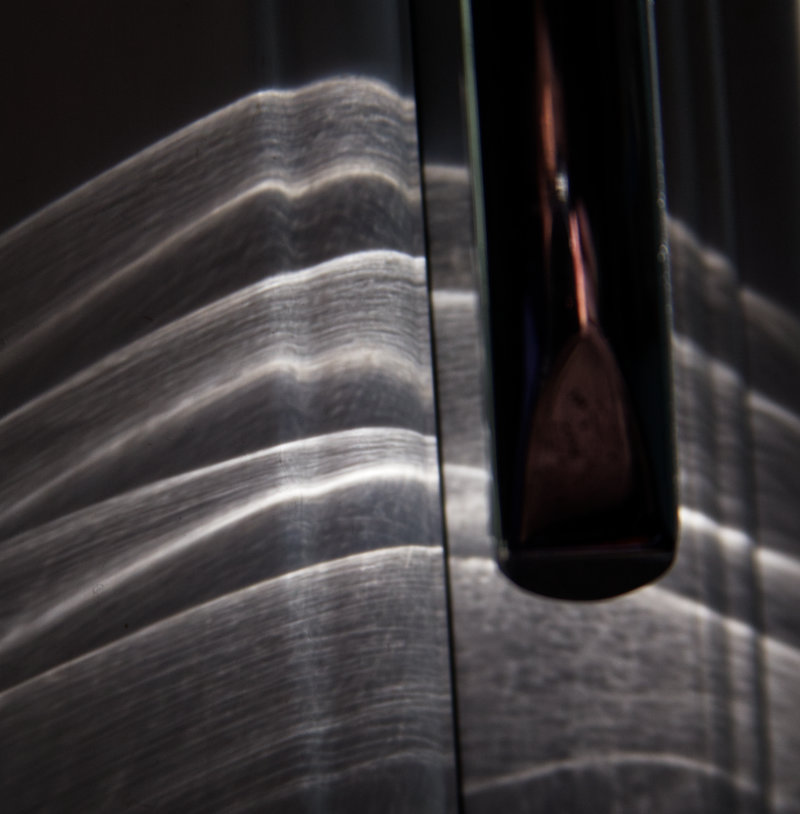
Just one photo today: the light reflected from the inside of a window handle
So anyway, it’s time for a review of the week. I deliberately didn’t set any goals for last week – I wanted to see what I naturally drifted towards, given the time. That makes it more difficult to assess how I’ve done, but I’ll have a go:
Things that went well
The Job Centre visit. This was a triumph, and the most significant event of the week. It means that I’m not under pressure to look for a job.
I started this diary site, and have kept it up. I never planned to make the site. The idea came to me last Saturday, and I think it’s a good idea. It will help me think through what I’m doing with my time.
I didn’t waste time. I felt motivated all week, and never found myself staring idly in to space and drifting about, not knowing what to do. In fact, I had the opposite problem (see “Things that went okay”).
I did an audit of my current sites and decided the next steps for each one.
I created a day bag, of all the things I need to explore the world, like a notebook, camera and sketchbook.
I started my printmaking course.
I took lots of photos. I also bought a new tripod, which is fabulous and opens up new possibilities, and I learned how to control my camera from my phone.
I learned about the Zettelkasten note-taking system. This could be handy in the coming months.
Things that went okay
Health. I ate reasonably well and went for two runs, but I missed a run yesterday and on Friday, and I didn’t do any strength exercises. I need to prioritise health more, because sometimes I had eye strain and burn-out from sitting too long at a screen.
Guitar. I stopped practising as the week went on.
Things that went badly
Drawing and painting. I didn’t do any.
My thought book. I haven’t started it yet. I need to create the website first, so that’s something for this week.
So for the coming week I need to:
Do cardiovascular and strength exercise every day, to keep fit and prevent burn-out.
Get my current websites complete enough so I can create content for them, especially the thought book site.
Carry on travelling to places, and taking notes and photos of them.
Keep this diary up.
Do some drawing. I’m not sure what the block is here. It may be that I’m scared my drawings won’t be any good, or that it takes time to draw and I haven’t slowed down enough yet. I’m thinking, “A drawing? That’ll take too long! I’ve got too much to do!” Let’s see if I can make time.
Carry on with domestic jobs, like tidying the garden and going to the tip. I don’t talk about these much, but they’re important to keep a sense of momentum and achievement. Of course, they mean you’re contributing to the family, but even if they weren’t, they provide a visual achievement. Unlike these more cerebral activities, they’re visible as you walk around the house or garden, and make your life feel less cluttered.
So overall I’d say it was a preparation week, and I think this one will be as well, but with more time than last week to spend on creating.
I’ve been trying to install Linux on an old Windows laptop, which is running too slow. I was hoping Linux would speed it up, because I need a laptop to work in the library, and I refuse to buy one. It’s such a waste when a computer is unusable after five years.
I tried Linux Mint, but the sound didn’t work. Linux is horrendous for drivers. If a driver doesn’t work, you have to stop there. If you start searching for how to get it to work then you enter a frustrating and time-devouring labyrinth, going one forum to the next, and one article to the other, with people pointing you in different directions saying, “It’s simple. You just do this”. But each way is a dead end. You have to be kind to yourself, and choose another Linux distro. I did, and it didn’t even boot. I’ll have to use the slow Windows for now.
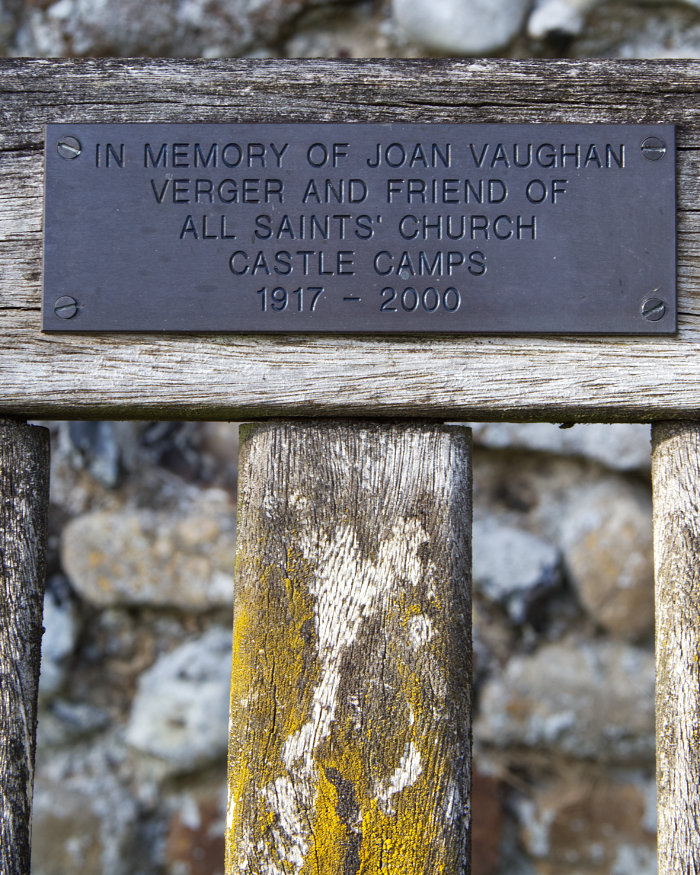
In the late afternoon, I drove up to Castle Camps church. I like it up there – it’s quiet and isolated. The church is down a singe track lane outside the village, on a hill that was an iron-age fort.
I arrived too late to go inside the church, but the bench outside was in the sunlight, so I plonked myself on that. I looked idly around the churchyard: the low sunlight streaked through the gravestones, and a thistle seed eddied through the air and snagged on the grass. I closed my eyes to enjoy the warmth on my face, and found myself listening for cars. I couldn’t hear any, just the leaves muttering, and the cheeps and chatters of birds. I began to doze off.
I was stirred awake by an aeroplane above. The church must be on the flight path to Stansted, because the sky was streaked with vapour trails, most of which had spread into long thin clouds. The aeroplane rumbled into the distance, the sound swelling and fading as it vanished behind a tall tree by the churchyard wall. For a while, I watched the tree swish in the breeze and then, from inside it came “Hoo hoo! Hoo hoo!” An owl at quarter past five in the afternoon. The bench was out of the sun now, and it was time to go home.
Here are some photos of the outside. Not thrilling pictures, I’m afraid, but just a bit of practice.
I drove one of my daughters to the next village to catch the school bus, and then parked and walked around. I’ve never done that before. I’ve always rushed straight back to get on with work.
When I drove into the village, I notice there were some interesting shapes on the church walls: angular shadows cast by the buttresses. So I took my camera and set off there. A woman came out of the house in front of me. She was tall and slender, with her white hair tied in a bun. She wore green wellies and pulled a shopping trolley. Where would someone be going with green wellies and a shopping trolley? They’re for two different terrains. I followed her to the church, where she turned in and went up to the church door. Perhaps she had decorations for the Harvest Festival.
I don’t like to disturb people in churches, so I started walking around the edge of the churchyard instead. Then I saw a man in the corner of the churchyard bobbing up and down from behind the gravestones. Maybe he was digging a grave. He looked red-faced enough, but he was also too old to dig graves. Perhaps he was just tidying a grave. Either way, I turned back. I like to be alone in these places, so I feel less-self-conscious.
So there we are: 8:30 on a sunny September morning in a churchyard. These are people whose lives I know nothing about, and would never have noticed if I was working.
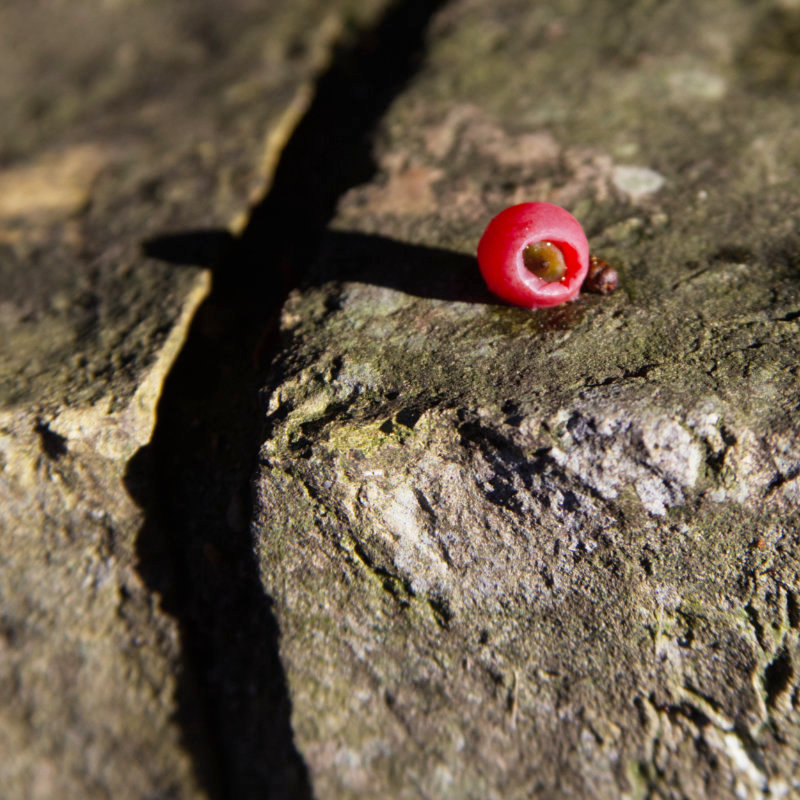
A yew berry this morning
Some yew berries had fallen on the church wall, and reminded me of an incident from when I was a child, about 8 years old. My mum took us to church each Sunday, and after the service people lingered outside the porch to chatter. My mum must have been talking to someone, because in a moment of idleness I picked up a yew berry and lobbed it into a jar on a grave. An old woman snapped at me. I don’t remember what she said, something like, “Someone is buried under there, show some respect!” It’s odd how I don’t remember her appearance – perhaps just a big coat and pointy glasses – but I remember her intent. I knew she was venomous and wanted to hurt.
One of my goals these six months is to make some websites. This afternoon I did and audit of the sites I have. I’ve decided to make seven, including this one, each using a different technology.
I was sitting in the garden this afternoon, looking up at our tall fir tree, when I saw two white butterflies high in the sky above. I’ve never seen butterflies so high. They were scuttering round and round each other, touching and recoiling, round and round whilst drifting across against the blue sky.
I said yesterday that today I’d take photographs of things that I’d otherwise pass by. So here we are, the photos I wouldn’t have bothered with today:
I can’t believe how little time I’ve got, even without working. I used to keep a spreadsheet of how I spent my time. I’ll have to do that now because I don’t know what’s happening to it. I’ll do a review of the week on Sunday, and see where I am.
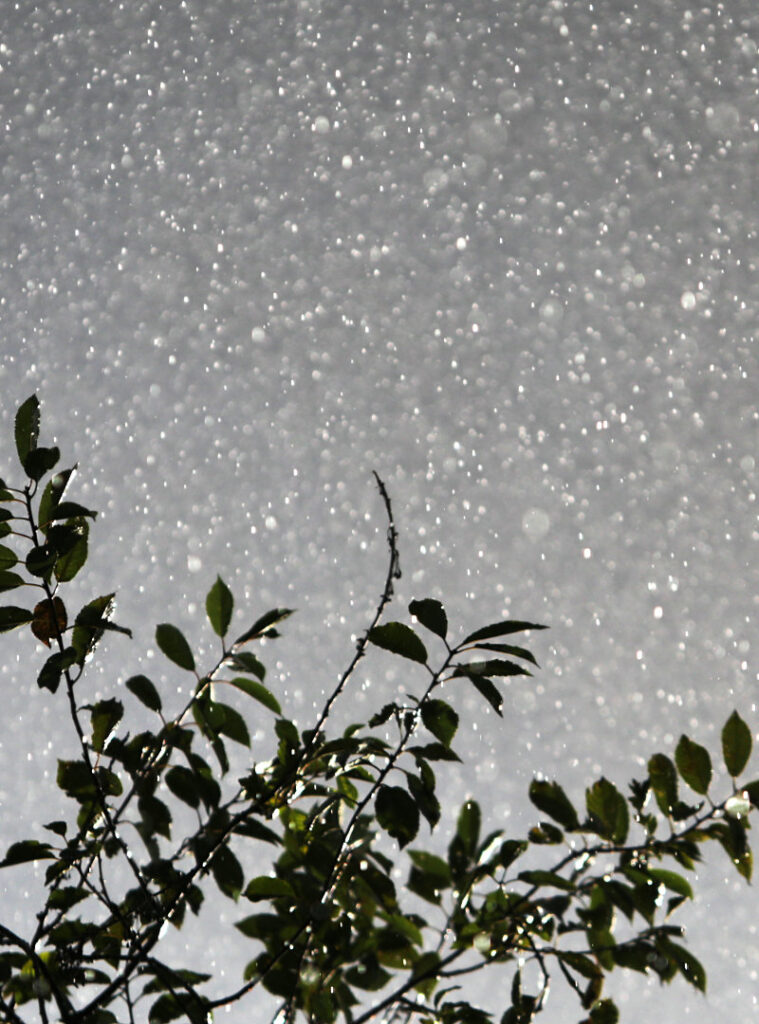
Today a dark cloud arose and unleashed a hailstorm. The sun was still shining, and made the hailstones glitter. I took a photo from the kitchen.
It’s strange how unfashionable wonder is. In my French class, we’ve just finished the novel No et Moi, which is a typical modern novel, especially one for teenagers. The assumptions are that people are selfish and life is miserable. Any happiness is a dim candle in a dark universe of suffering. I feel sorry for the authors, and I’m glad I don’t meet them at dinner parties.
I think of what Dickens said towards the end of Pickwick Papers: we mustn’t be like bats and owls and only develop eyes for the darkness, but we must be able to see the light between the darkness. It’s not even difficult. Physical light is a good place to start.
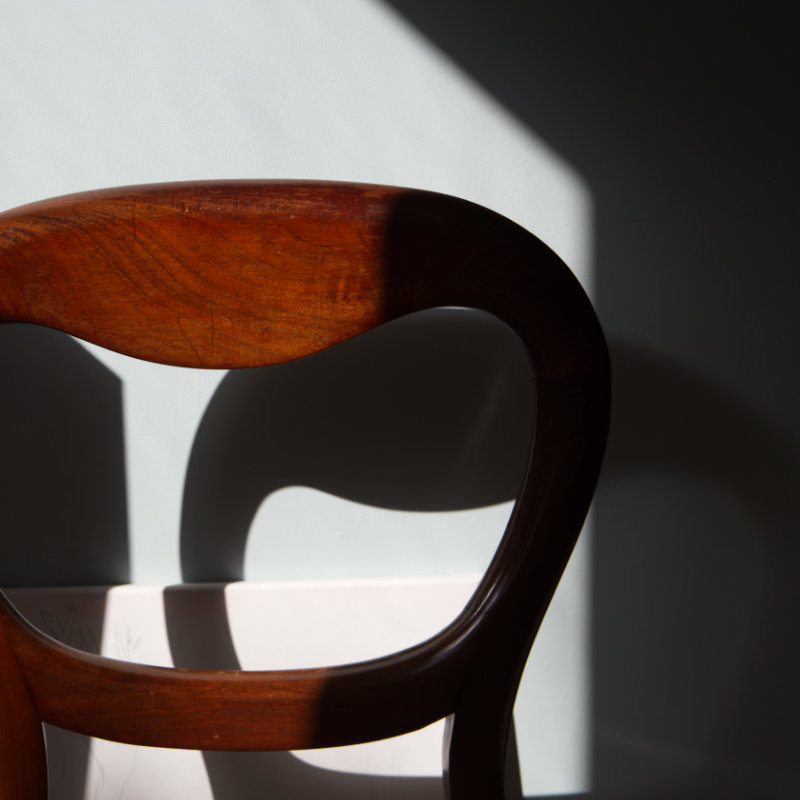
I paused several times today to look at light coming through a window and across a chair or down a wall, and I thought, “Should I take a picture of that?” I don’t know why I found it fascinating. I just know fascination isn’t captured by a camera, so I didn’t take a photo. Do you know what? Maybe I’ll try next time. That’s the point of these six months: to stop more.
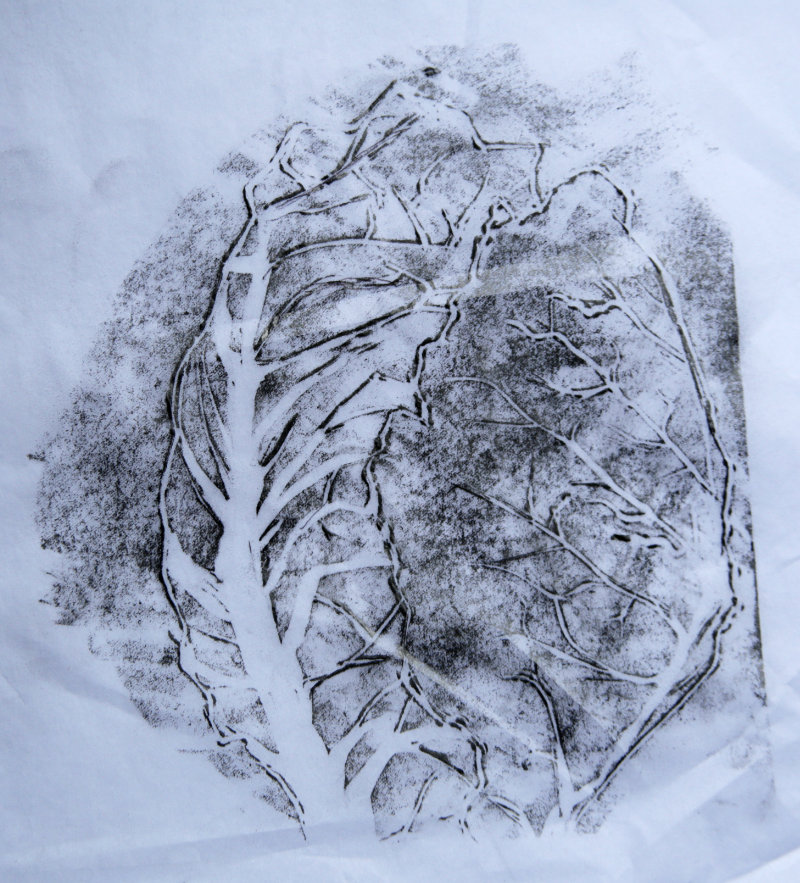
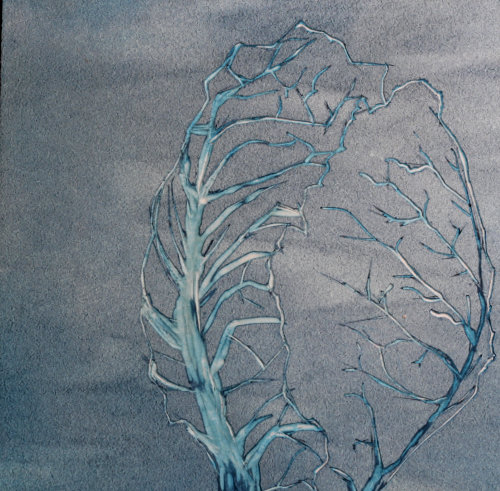
Incidentally, I found another cabbage picture today. It was a graphite rubbing of the linocut. It’s how you get a preview of a print: you put tracing paper over the linocut and rub it with a graphite stick, and then you’ll see if your lines are deep enough and in the right place. I like the image. I wonder if there’s some way you could do a rubbing of a photograph.
It was the first day of my “Introduction to Printmaking” course today. I took a few black and white photos in, some by me and some by Edward Weston. The teacher gave us an introduction to linocut, and then said to me, “I think you should use one of your own photographs. The one of the cabbage will work well.” Here it is:
So she gave me a sheet of carbon paper so I could trace it onto the lino. I was a little taken aback because tracing felt like cheating. Shouldn’t I be drawing the cabbage? Then I was comforted by two thoughts. One, I was here to learn printmaking, not drawing, so I just needed an image to practice cutting lino and printing. Two, isn’t printmaking a mechanical means of production anyway? Tracing a photo means printmaking can fall between art and photography. It can be more selective and creative than photography, but not as free as art.
It can be arty, or course. You can draw anything you want as freely as you want on the lino, but I actually got interested in the relationship that printmaking can have with photography. I’ve felt for a while that photographs are a step on a journey, not an end-point. They’re not expressive or idiosyncratic enough for me. Most of my photographs feel like they need more work to make them interesting, more human intervention so they express how I experience what’s in front of me, and not just record what’s there.
Here’s the cut lino plate:
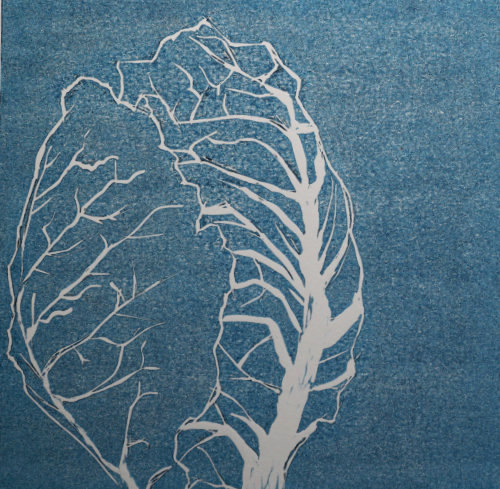
The photo was taken after the printmaking, so the residue of blue ink is still there. The original lino plate was white. One thing I never thought about was that if you cut text or a famous place, then you have to cut the image in reverse, so it will be right way round when you print it.
We tried a few hand-printed images, but I preferred the ones done by the presses. The hand-printed ones didn’t show the lines so well.
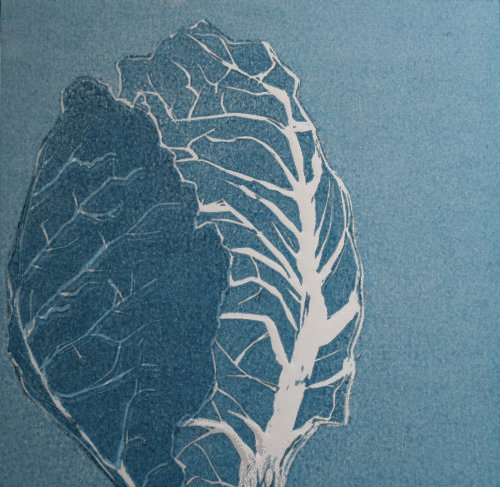
Here are a few prints from today:
In hindsight, I don’t think the cabbage was good image to choose. The lines of the lettuce veins are interesting, but the overall shape is dull. It’s just a shabby oval. Next time I’ll choose something with a more interesting form.
It was a fantastic day, and has made me think more about how to take photography on.